Chapter 2 · The On-Ramp
Making Your Mark as a Mass Tort Lawyer
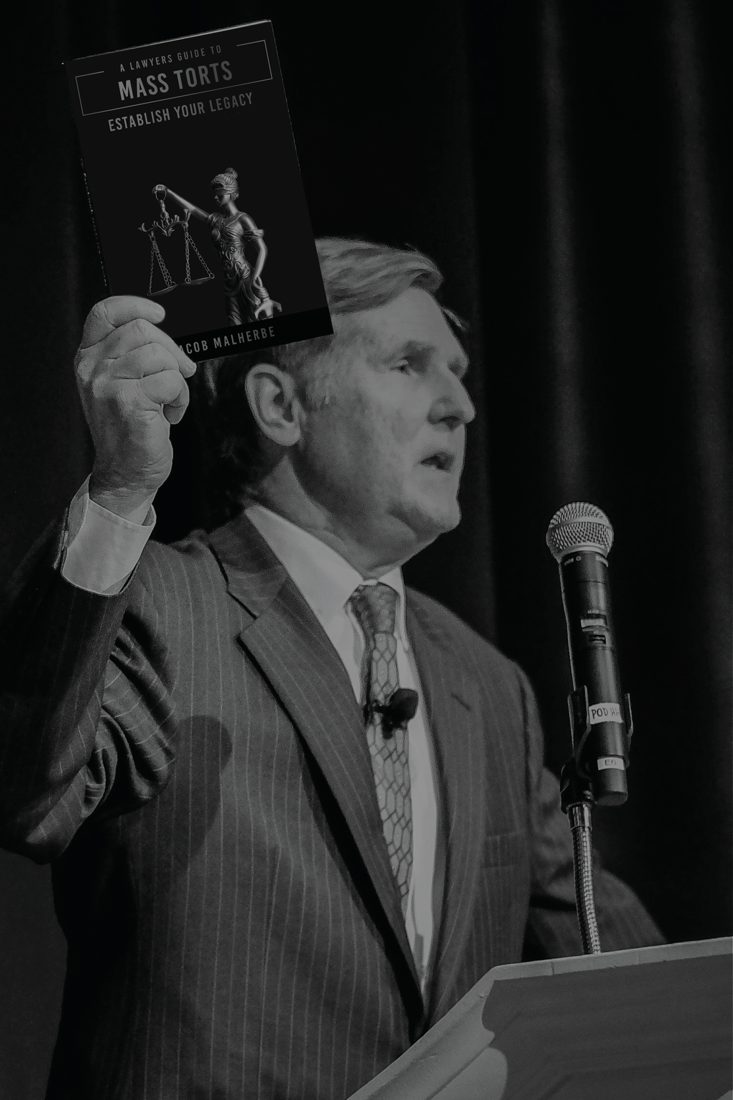
Step forward—odds be damned—and fight for what’s right.— Mike Papantonio
Mention the phrase “mass tort lawyer” to most of the attorneys I work with and they’re likely to think of one person in particular: Mike Papantonio of Levin Papantonio.
Mike is nothing less than a living legend in our field— one of the few living lawyers who’s been inducted into the Trial Lawyer Hall of Fame—and is the de facto patron saint for victims of corporate negligence and wrongdoing. He’s seen it all and pretty much done it all, having won more multimillion-dollar settlements than I can count. Furthermore, he’s a born connector. He not only knows everyone in our field but he’s committed himself to ensuring that the bonds between plaintiff -side lawyers continue to expand and strengthen year after year. Which helps explain why his Mass Torts Made Perfect (MTMP) conference is the single can’t-miss event on all of our calendars.
Based on his extraordinary résumé and celebrity-like status, it would be easy to assume that Mike wouldn’t have the time to mentor young and up-and-coming lawyers. But point of fact, nothing could be further from the truth.
Mike is a mentor in every sense of the word. I recall back in 2015 when he invited me to give my first presentation about Facebook advertising at MTMP. I watched as he wound his way through the conference room, past a parade of outstretched hands and clapping lawyers, to seek me out and thank me for discussing the importance of data retrieval and Facebook advertising. He treated me like a member of the club from the first moment I met him, as he does everyone who is new to our field.
We share an unyielding conviction that some things really are black and white, especially when it comes to standing up to corporate neglect and malfeasance. We share a sense of outrage over injustices felt by victims and an impassioned desire to help right those wrongs.
We’ve learned a great deal from each other over the years, which is why we consider each other friends as well as trusted colleagues. Mike is an extraordinary writer, which is why I asked him to be the lead contributor to this book.
His legacy is beyond compare. But what continues to impress me, year after year, is his ability to build an everexpanding network of top-tier lawyers. He’s managed to not only assemble a team of extraordinary legal minds but has found a way to remain extraordinarily hands-on in regard to his tutelage.
Despite his success, Mike not only remains open to new ideas but seems energized by them. When I described, back in 2015, the potential power of leveraging Facebook to find new clients, he not only grasped the underlying technology quickly but he was clearly excited at the prospect of reaching out to victims who might not otherwise have found their way into a tort.
As my own company, X Social Media, has grown, I’ve tried to emulate Mike’s own bedrock philosophies. I always reserve time to talk to everyone who comes into my orbit, taking as much time as is required to educate them about the inner workings of our field, the power of Facebook advertising, and the future direction of our industry.
Anyone who possesses even the slightest curiosity about transitioning into the mass tort space needs to read on. Mike’s insights and aspects of his personal story will motivate you, while providing you the assurance that a successful and fulfilling future is well within your reach.
—JAcoB MALHerBe
Myopic (adjective): (1) the inability to clearly see objects that are far away. (2) lacking in foresight or discernment: narrow in perspective and without concern for broader implications. (3) a fear-driven trait seen overwhelmingly in the legal profession, especially in lawyers who talk themselves out of taking risks for the good of their careers and their clients.
wHAt Are You really afraid of? That’s always the question I pose to lawyers who show an interest in migrating into the mass tort space.
Most of us who’ve chosen to be plaintiff-side mass tort lawyers can’t imagine doing anything else. Our field gives us the opportunity to work on important big-time cases. It dangles the potential to earn hefty settlements, and it enables us to do some good for thousands—if not hundreds of thousands—of victims.
Mass torts touch so many different sectors of society: the medical industry. Local communities. The country. Other countries. The environment. And the planet as a whole.
It’s rife with possibilities, just dangling there like low-hanging fruit, yet I’m always surprised at how few lawyers have the courage to take action and enter our space. I’ve seen it so many times. They simply freeze up before they fully commit to the move. The natural inertia that shuttled them along to the moment of decision somehow comes to a screeching halt just before a stifling blend of fear and doubt sets in.
Apprehensive voices emerge. Maybe you’ve heard them yourself. “Take the leap? Can’t do it,” your inner voice says. “Not now, at least.” That’s usually the first trip wire, the justification lawyers use to talk themselves out of an important career shift. “Too risky. Maybe I’ll do it later. Maybe a couple months from now. Maybe next year.”
They blink. They physically and metaphorically blink. They start looking at a potential career change from oblique and self-defeating angles until they talk themselves into the comforts of maintaining the status quo. Staying on the beaten path is always the easier play, but in most cases, it’s also the wrong long-term decision.
I know lawyers. I’ve been a lawyer my whole life. I’ve written three books about lawyers and the legal field, so I know with absolute certainty that most lawyers shudder at the prospect of rejection and failure.
Let me offer a simple analogy. This is a true story. I was visiting Northern Spain one afternoon, when I came upon a beautiful art gallery. There were artistic treasures everywhere, but my eyes were immediately drawn to one painting in particular. It looked, from afar, like a jumble of colorful tiles, a complex mosaic of cubes painted on canvas.
Initially, my eyes didn’t know where to focus. There was a woman embedded in the middle of the painting. I could see that immediately. She appeared to be standing at a window, looking out over the sea. In the top right corner of the painting glowed an orange sky. A quirky line illustration of a man or woman—it was hard to tell—filled the bottom quadrant. All of this was bracketed and bordered by other small cube-like images scattered around the canvas.
Only, that’s not what jumped out at me as my eyes refocused. I could see that each cube had been carefully arranged. By tracing my eyes along the darker-shaped cubes, I could make out a profile of President Abraham Lincoln in the center of the piece. It looked a bit like the image of Lincoln you would see on a five-dollar bill.
Noting my interest, the owners of the gallery approached me and asked what had caught my eye. I told them that I was impressed by the artist’s ability to capture Lincoln in such a novel way.
They smiled.
Turns out, the piece was by Salvador Dalí, which explained a great deal. The gallery owners informed me that most visitors can’t see the image of Lincoln amid all the color splotches. Sometimes, a gallery representative would go so far as to tell customers to look for the portrait of Lincoln—and even then, some still couldn’t see it.
Which begs the question: Were they really unable to see what was actually there or were they choosing, on some conscious or unconscious level, not to see it?
My encounter with Dalí captures the psyche of so many lawyers working in our field. Great swaths of attorneys, if you’ll excuse my candor, are very simple-minded thinkers. They choose to see the world in one dimension instead of three.
Some have brilliant minds, capable of untangling great Gordian knots of legal prose. But many of those same attorneys are shockingly linear in their approach to business. They display a confounding inability to step outside of their comfort zones and pursue different areas of the law.
If you don’t believe me, flip through Clarence Darrow’s fantastic autobiography, The Story of My Life, which devotes plenty of ink to the idea that most lawyers are severely lacking in both innovation and creativity. Generally speaking, Darrow says that lawyers don’t read enough beyond their safe little bundles of dry legal documents. They don’t write enough. They don’t create enough.
Darrow leveled all these critiques back in the 1930s. Can any of us honestly argue that our profession has improved much since then?
If anything, new tools and technologies have made it easier for lawyers to stay cloistered in their self-constructed cocoons. Our field’s systemic weaknesses (i.e., a pervasive fear of taking on new challenges and broadening the scope of our work) tend to get passed down, generation after generation, from one lawyer to the next.
How should you practice law? Well, the old guard will tell you to simply do what they have always done. Rinse. Wash. Repeat. You want to help injured victims? “Keep thinking small,” they’ll tell you. Car wrecks. Slip and falls. Maybe a medical malpractice case here and there. But what they’re really telling you is, “Keep practicing the law the way I practiced the law.”
What they often fail to mention, however, is that they stick to what they know because they don’t have the courage to try anything different.
In my opinion, this kind of cloistered thinking is the unavoidable by-product of holding a rather myopic view of who they are and what they can do. They can’t see the possibilities—the shapes and images within the larger canvas—that lie right before their eyes.
My advice to young lawyers is simply this: Don’t allow yourself to make that same mistake. Sometimes you have to break away from the confines of the status quo in order to outgrow it.
Here’s what you should do: Take that comfortable old coffee cup that you sip from every morning and heave it so hard against the wall that it smashes into a thousand pieces.
Go out there and upend your tired, rote, and undeniably comfortable routine. Smash all those psychological barriers and untangle all those safety nets that you’ve surrounded yourself with. And then take the leap. Get out there and start anew in a field, like mass torts, where you can do a profound amount of good while making good in the process.
Until you can compel yourself to do that, you’ll never discover what you’re truly capable of achieving in the field of law.
If you want to wake up every morning and know—deep in your bones—that you’re making a lasting impact on the world, what’s stopping you?
One day, years from now, when your grandchildren and greatgrandchildren ask you what you did for a living, what are you going to tell them? Wouldn’t it be nice to tell them that you helped save thousands of lives by forcing corrupt companies to stop selling products that were killing people? Don’t you want to tell them that you helped clean up the environment? That you stood up to money-hungry corporations for the betterment of your fellow citizens and the world around you?
If that seems like a worthwhile aim, ask yourself an even tougher question: “Am I doing the work today—right now—that’s going to produce such a legacy?”
If you’re not, it’s time to make a change.
The good news is that there are plenty of extraordinarily successful attorneys and vendors working in the mass tort space today— including contributors to this very book—who can help you make that transition.
All it takes on your part is the courage to say, “I can do better. I can do better for myself. I can do better for my family. I can do better for my business partners; I can do better for the scores of people who’ve been wronged by faceless and negligent corporations. And I can do better for the broader community in which I live.”
When I was researching my book Resurrecting Aesop, I sent out two thousand questionnaires to lawyers around the country. I read their responses, then forwarded them on to psychiatrists for further analysis. It was an enlightening project because it helped prove something I’d always believed. Namely, that the biggest roadblock for growth lies in lawyers’ inability to change their areas of focus.
Personal injury lawyers, for example, seem to gravitate to automobile cases simply because everybody around them does car-wreck cases. They run those horribly mundane TV ads because that’s what their peers do. It’s a classic case of “lawyer see, lawyer do.”
Most lawyers are terrified of rejection, which prevents them from reaching out to other lawyers who can assist them. Lawyers are deathly afraid of sounding uninformed or slightly behind the technological curve. And it’s precisely those fears that prevent them from calling up a vendor, like X Social Media, and saying, “Can you explain how you use Facebook to find mass tort victims?”
Feelings of inadequacy—not to mention envy or the prospect of rejection—ultimately prevent lawyers from calling up a top-tier firm like ours and saying, “I’d like to participate in the Zantac mass tort or the Fire Foam mass tort, but I need your help.”
Most lawyers are terrified of rejection, which prevents them from reaching out to other lawyers who can assist them.
Ultimately, it’s those knee-jerk fears—the little voice that whispers, “I’ve never done that before; therefore, I can’t do it now”— that are so self-destructive.
So let this book—and some of my life experiences—act as a formal introduction to the world of mass torts. If you can see what I’ve seen and experience a little of what I’ve experienced, perhaps you’ll be encouraged to make the move yourself.
Chances are there’s something in your own life story that can stoke your own internal fire. We all need, on some level, to be able to articulate why we’ve chosen our given profession.
We are all shaped by our own respective upbringings. That was certainly true for me, as I was raised by eight different families growing up. There was dysfunction in my life from the word “go.”
Every one of those families was composed of hardscrabbled bluecollar workers, decent people who found a way to cobble a living out of blood, sweat, and tears. Which is why I feel an innate kinship and appreciation for the workingmen and workingwomen of this country.
I realized, early on, that the deck was stacked against them. I saw how they could be abused in so many different ways by so many different people. The insurance company that offers them an overpriced policy. The corporation that sells them dangerous products. The employer who cuts costs and cuts their job along with them. And the lender who unjustly forecloses on people’s homes.
We all have our own stories. We’re all affected by our own individual life experiences. But at some point, you have to make a decision: Are you going to adopt a passive approach? Are you going to cement your feet to the ground and forever remain where you stand? Or are you going to take a more active approach? Kick the dirt out of your way, force change upon yourself, and move forward?
Finding a trusted mentor always helps, but sometimes, mentors find their way into your life in unexpected ways. You can’t be myopic in this regard either. I’ve had my share of mentors over the years. Look no further than my partner and mentor, Fred Levin. But one of my greatest mentors happened to be nothing more than a figment of a writer’s imagination: namely, Atticus Finch from Harper Lee’s book To Kill a Mockingbird.
Atticus Finch has been such an important figure in my life that I wrote my first book, In Search of Atticus Finch, about him. That book still sells like crazy, and it’s still taught in law school classrooms across the country because Finch represents a set of ideals we should all strive to emulate.
He’s a character living in the Deep South who sweeps aside overwhelming odds by representing a black man who’s been accused of raping a white girl. Mission impossible, right? But does he say, “I can’t represent my client”? Does he talk himself out of doing the right thing? Does he throw up his hands and say, “It would be a hell of a lot easier to sell out on this one and go back to handling traffic cases”?
No, he steps forward—odds be damned—and fights for what’s right.
That’s the kind of lawyer—and the kind of odds-defying philosophy—I’ve tried to emulate in my own practice. And there’s absolutely nothing stopping you from identifying your own inspiration, whether it’s a flesh-and-blood person or a fictional creation, and doing the same.
Do what you need to do to connect with lawyers whom you admire. Pick up the phone, schedule a meeting, write an email, send a text, or connect via social media.
Try adopting a habit I developed when I was younger. Go out and buy two pads of paper and lay them down on your desk. On one pad, write down all the people you’ve previously worked with and want to work with again. And make it a priority to stay in contact with them.
Then, on the second pad, write down the names of people you’ve never met but would like to meet someday in the future. You can write down the names of activists and vendors and politicians, but make sure you write down the names of lawyers in the mass tort space who’ve actually accomplished something of note. People you’ve read about or admired from afar. Then make it a priority to cross paths with them.
Those simple pads of paper helped me establish myself in this industry. The great plaintiff-side lawyer David Shrager was one of the names on my “I-want-to-meet” list. I must have been in my midtwenties at the time, while David was busy winning trial lawyer of the year awards. I didn’t know him from Adam. I guess I could have talked myself out of taking that leap of faith—I could have let the fear of rejection overwhelm me—but I didn’t.
I picked up the phone and kept calling the man. My pitch was simple: “I don’t know you; you don’t know me, but I’m very interested in what you’re doing with your HIV cases. I’d like to come meet you.” Having a few early trial victories under my belt certainly helped, but he was gracious enough to agree to a meeting.
So I met David in central Florida. I had studied the HIV cases he was working on, so I told him, straight up, that I could help him on the trial side of the equation. He’d surrounded himself with strong appellate lawyers, but it was clear to me that they lacked the trial skills required for a case of this magnitude.
Had David been a different kind of guy, he might have thrown me out on my ass. But I was honest and authentic. I felt that his team needed someone like me—someone who believed in what he was doing and possessed the trial skills that could help the victims he was representing.
I knew, even back then, that if I’d never tried—if I would’ve just stayed home—I would have regretted that decision for the rest of my life. So I went for it. And David saw enough in me to welcome me onto his team. In time, I did exactly what I said I was going to do. And together, we accomplished something noble: We were able to get the product, Factor VIII, off the shelves and save thousands of lives.
I mention this story because it underscores just how much the plaintiff-side world of mass torts is—and will always be—a team sport. For those who are afraid of rejection, know that the best lawyers in our space always leave the door open to field questions and recruit new talent.
The plaintiff-side world of mass torts is—and will always be—a team sport.
I’ve always believed that whenever lawyers become too protective of their own businesses, they do so at their own peril.
There’s little room for uppity, self-important lawyers on the plaintiff side of mass torts because our end goals should always be the same: Find justice for our clients. At our firm, I’m willing to get rid of people at the drop of a hat if I find they’re not offering more to our co-counsels than we’re taking from them.
It’s such an enduring philosophy of mine that I built it into our mission statement. I firmly believe that we are all at our best when we adopt an inclusive mindset. Not you. Not me. But us. No one can ascend within the mass tort space by themselves. Success requires teamwork and lawyers who possess different skill sets.
In any mass tort case, you need finders, builders, technicians, trial lawyers, and backers. Finders find and vet the torts worth pursuing. Builders build the consortium of lawyers who will oversee the case. You also need technicians, lawyers who excel at filing the motions and working up briefs. From there, trial lawyers handle the actual casework: They oversee discovery, take depositions, and try the case. You’ll hear from a collection of lawyers just like these in the chapters that follow.
But you also need a consortium of law firms who have the financial wherewithal to see the case to its logical conclusion. Consider a contemporary mass tort, like opioids. The costs required to bring mass torts to trial has risen beyond $200 million and will continue to build as it progresses to settlement.
You may come across people in your career who think they can do it alone. Take it from me: They will fail—and fail miserably—if they don’t change their philosophy. They might not fail the first time, but they will ultimately fail in the long run.
It’s like executing a running play in the NFL. You need synchronicity. A good snap. A smooth quarterback pivot. Everyone needs to know their own individual blocking assignments. You need your guards pulling even before the handoff has been made. You need your wide receivers stretching the field to draw those cornerbacks and safeties away from the line of scrimmage. You need the tight ends to seal the edges. You need a hole to open up and the running back to have enough vision to see it, plus the speed and agility to hit that hole when it emerges.
My point is this: Those who enter our profession with a willingness to be a team player and build camaraderie will not only get noticed but their openness to collaboration will be rewarded tenfold.
The other essential attribute that a new mass tort lawyer must possess: energy.
I’m a firm believer that energy attracts energy. If you can generate and harness enthusiasm, it can literally light up a room.
Those who enter our profession with a willingness to be a team player and build camaraderie will not only get noticed but their openness to collaboration will be rewarded tenfold.
That’s one of the reasons why, more than twenty years ago, I launched a plaintiff-side conference called Mass Torts Made Perfect.
MTMP, as we now call it, is the largest plaintiff-side mass tort gathering in the world, which brings together more than 1,800 people two times every year. Why has it been so successful? Because of the sheer amount of energy and passion we pack into it. There’s nothing static about our conference. We created an event that inspires people. It’s designed to be one giant conduit for energy. It connects people. It educates people. It motivates people. It shapes people. It bonds people. And it encourages all attendees to soak up that energy, take it out into the world, and amplify it further.
People are drawn to enthusiasm, confidence, and success. Newcomers to our field need to see it. Hear it. Feel it. To know that it’s real.
It’s like when you used to chase lightning bugs or fireflies when you were a child. You see those flashes of light, pulsating in the night, and you can’t help but want to preserve them. That’s what we’ve done with MTMP; we’ve bottled lightning—and we share it with our fellow plaintiff-side lawyers so they can go out and feel emboldened to change the world.
So be your own firefly. Go out there and light things up. That’s my message. Don’t be myopic. Don’t avert your eyes from the light. Start visualizing your future. Right now.
And don’t be cynical. When you read about mass tort lawyers who’ve won incredible settlements on behalf of their clients, don’t minimize their achievements. Don’t negate that positive energy by saying, “Oh, they must have caught a break, or I could never do that.”
Don’t beat back the prospect of success. That’s the kind of thinking that will keep you in a state of perpetual stasis. Oftentimes, luck is a by-product of hard work. Sometimes the harder you work, the more lucky you become.
There’s a bedrock sales philosophy that all lawyers should remember: Success isn’t the result of being a great closer; it’s the result of showing people what you’re selling.
It doesn’t matter if you’re the greatest closer in the world. If you don’t have the courage to show people what you’re selling, you’re never going to sell anything.
There’s a bedrock sales philosophy that all lawyers should remember: Success isn’t the result of being a great closer; it’s the result of showing people what you’re selling.
You’re a great closer in the courtroom? That’s fantastic. But the real question worth asking is how many sales calls have you made? Are you continuing to add more meetings to your calendar? Or are you standing pat and actually leaving money on the table? Because if you were to add twenty more meetings to your calendar, you’d bring in a hell of a lot more money, wouldn’t you?
The same principle applies to the legal profession. You’re a great personal injury lawyer? That’s great. Congratulations on the toil and trouble and hard-earned luck.
But the question I have for you is this: Have you considered what you could achieve if you expanded beyond car wrecks and slip-and-fall cases into mass torts? What could you achieve beyond single-event cases in a field in which hundreds and thousands of clients can earn a settlement at one time? Think less about what you’ve closed and more about what you could close if you visualize a different future.
It comes down to expanding your viewpoint. Stop being myopic. The more effort you pour into diversifying your docket, the more successful you’re going to be in the long run. Don’t be afraid to try cases and talk to clients that are beyond your wheelhouse because, at the end of the day, that’s going to generate more good than simply honing the skills you currently possess. Go do the things no one thinks you can achieve, and you might surprise yourself.
That was certainly the case when my partner, Fred Levin, and I decided to take on big tobacco in the early 1990s.
One day we sat down together in Pensacola, Florida, and decided to attack big tobacco from a different angle. There had been previous attempts, mostly unsuccessful, to sue individual tobacco companies. Smokers were obviously developing cancer due to cigarettes, but the failure rate of these individual cases was proving absolutely massive.
We figured out that the losses were due to rationalizations. Juries and judges would look at individuals and say, “Well, they made the decision to smoke, so in some ways, they brought this upon themselves.” We realized that people didn’t fully understand the addictive nature of tobacco.
That’s when it hit us: Perhaps the better approach would be to bring our evidence to state attorney generals and show how tobacco was causing their individual Medicaid systems to lose billions of dollars every year. It was the states, after all, who had to pay the medical bills for all the cancer cases and heart failure procedures that cropped up as a result of cigarette use.
We compared cigarette use to other mass torts. It was the equivalent, we argued, of large corporations moving into a state and throwing toxins into their waterways. If companies were being forced to clean up the toxins they’d dumped in their water systems, shouldn’t big tobacco have to pay the Medicaid costs that cigarettes produced?
That argument clicked with a handful of attorney generals and quite literally changed the course of history. We led the charge, which ultimately forced big tobacco to pay more than $260 billion in settlement costs, over the next twenty years, to help defray state Medicaid costs.
In addition, our work forced the tobacco industry to spend hundreds of millions of dollars to educate people about the dangers of smoking. These measures undoubtedly curbed the use of tobacco. Estimates vary, but some suggest it reduced tobacco use by 40 to 50 percent, thus saving untold number of lives in the process.
But we didn’t stop there. We kept fighting. When I learned that C8, a dangerous cancer-causing toxin that’s produced as a byproduct of manufacturing Teflon, was being pumped directly into the Ohio River and into the homes of local residents, I was absolutely outraged.
Never underestimate the power of righteous anger. Sometimes, all it takes is a healthy dose of outrage to set a campaign in motion. I didn’t know anything whatsoever about C8, so I sat down, studied the issue, and became even more enraged at DuPont and its manufacturing processes.
I felt in many ways that it was my responsibility to take on the case. It started out, simply enough, as an environmental case. Initially, we assumed the C8 runoff was only affecting a handful of people, but in time, we found that it had affected as many as seventy thousand people along the Ohio River Valley. We not only learned that DuPont had been poisoning waterways for fifty years but that leadership seemed to know it was causing cancer yet continued to do it anyway.
We tried five test cases and won all of them, providing restitution for thousands of people who had contracted cancer through no fault of their own. Furthermore, our work forced local municipalities to clean up their water facilities, which might have saved thousands of additional lives moving forward.
I recount this story because it’s a prime example of how the simple act of doing the right thing when an opportunity presents itself can have profound long-term effects.
Over time, our investigation into C8 led us to look into another dangerous set of compounds called PFAS, which stands for per- and polyfluoroalkyl substances.
PFAS is a group of chemicals used to make coatings and products that resist heat, oil, stains, grease, and water. Our investigation led us to look into Fire Foam. The use of Fire Foam may be spreading C8 like an incurable disease in acrophores and waterways all over the planet, which I predict will be one of the most important environmental cases of our time.
We found that PFAS are biopersistent and bioactive products, which means they not only accumulate over time in your body but can also do serious damage to people’s nervous systems and organs over time.
If the prevalence of PFAS doesn’t provoke anger in you, I don’t know what will. They can cause birth defects and gastrointestinal issues so serious that some people have had parts of their stomachs removed. It can cause testicular cancer and kidney cancer. And that’s just the short list.
This is not mere speculation on my part. We’re way beyond speculation. The documents we’ve pored over may be the most conclusive and damning evidence I’ve seen in the last twenty years.
You run these findings across the desks of most lawyers—I don’t care who they are—and they can’t help but ask, “How is this happening?” My answer is simple: “Yes, but it is happening. So now what are you going to do about it?”
If you read those documents, you should be motivated to join us. We can teach you how to help us. We can help you build a mass tort practice and be part of the solution to the problem.
The risk is always worth the rewards in situations like these. Consider for a moment a mass tort like the one involving YAZ birth control pills. Think for a moment about the devastating effects that these pills had on women’s bodies. At one point, the FDA recognized that the product may have killed or crippled hundreds of women every year.
When capitalism works, it’s the greatest system in the world. When it doesn’t work, it’s one of the most destructive forces in nature. In the case of YAZ, I believe the FDA allowed the pill to be sold on the open market due to political influence. You had politicians working hard to push the FDA.
And then the industry went out and hired what we call biostitutes—rhymes with prostitutes—to defend that decision. Biostitutes are doctors and scientists who will say anything for the right amount of money. But in this case, some of these so-called thought leaders turned out to be frauds. Rank ugly frauds. They had to have known that these products were killing people, but for the right amount of money, they would go out and tell other doctors to prescribe them.
And did the media look into this? No, because they were making so much in advertising dollars that they simply looked the other way.
I understood this was the kind of case where we had to deviate from the norm. We had to go where other lawyers had feared to tread. So we looked into the history of the Bayer Corporation. Not very many people know this, but Bayer has a very checkered, if not ugly, past. A former leader of the company worked with others to produce Zyklon B gas, which was used to kill people during World War II.
That was one of the stories that had been suppressed for so long. So we brought it out into the open. I remember we were in court in St. Louis, when the judge in our case indicated that he was going to let some of that evidence proceed. And at that point, the media had to cover the story. We forced the media’s hand, changing the momentum of the case.
Eventually the case settled for billions of dollars, but it underscores the importance of what we all do in the mass tort space for a living. We shine a spotlight on corrupt, ridiculously incompetent politicians. We question the FDA. We unearth dangerous history. We stop products from killing people. And we do it all in the name of the victims who need legal representation.
It’s one of the reasons why, to echo Clarence Darrow, I believe lawyers need to get more creative and innovative. We never do things alone. It always takes a collective effort. As plaintiff lawyers, we have to join arms and work together. We have to help each other banish our fears, whatever those fears may be. We have to ensure that the marginalized have a voice.
These mass tort victories aren’t the equivalent of dropping pebbles into placid water; it’s more like dropping huge boulders and creating giant tidal waves. All you need to do is experience it one time, and you’ll be hooked.
Yes, you can make more money than they’ve ever dreamed of, but that’s not the true reward. The real reward will come years from now when you’re sitting down with your children or grandchildren or great-grandchildren and they ask you, “What are you most proud of? What’s your legacy?”
Don’t you want to say, as I will, that you played a part in taking dozens of dangerous chemicals off the market? Or that you forced companies to add black box warning labels to pharmaceuticals that otherwise would have injured or killed tens of thousands of people? Or that you cleaned up waterways and literally blocked dangerous toxins from destroying the earth?
Yes, you can make more money than they’ve ever dreamed of, but that’s not the true reward. The real reward will come years from now when you’re sitting down with your children or grandchildren or greatgrandchildren and they ask you, “What are you most proud of? What’s your legacy?”
If that doesn’t appeal to you, then perhaps you should look to a different field of the law. But if it does appeal to you, consider this book to be your invitation to make a real difference. You have the same law license that we do. So reject the doubt and fear of the unknown. Forget about what you can’t see. Don’t be myopic. Look at what lies within your grasp. Refocus. Now, open your eyes and grab it.