Chapter 8 · The Great Differentiator
The MTMP Experience
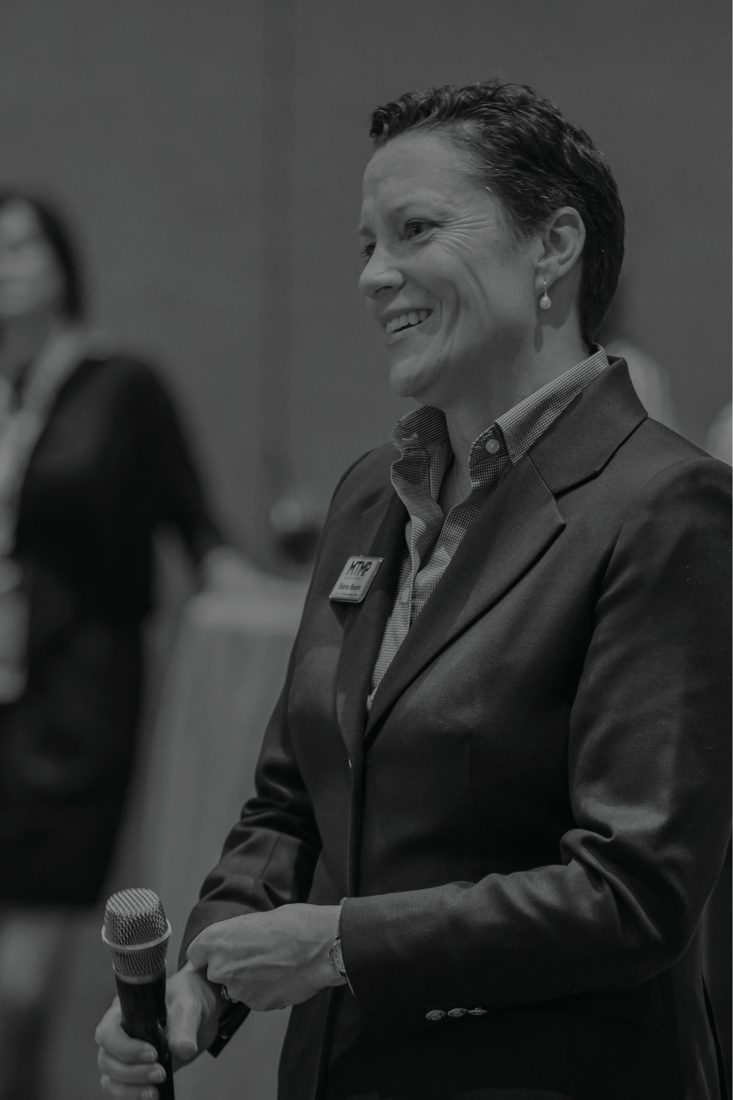
We feel emboldened to join with an even larger group of like-minded crusaders and engender real change on a societal level.— Sharon Boothe
Mention the acronym MTMP to most mass tort lawyers, and they’ll flash a knowing glance and a wide smile. Mass Tort Made Perfect (MTMP) is the only plaintiff -side lawyers conference in the country that focuses exclusively on mass torts. Other conferences are open to both plaintiff -side and defense-side mass tort lawyers—a huge drawback as we will show later—or invite an eclectic mix of lawyers practicing in different areas of the law.
Not MTMP, which is focused like a laser beam on plaintiff -side mass tort issues. It’s a one-of-a-kind experience, which I recommend for anyone in the field, whether you’re a seasoned pro, a lawyer interested in breaking into the field, or a vendor seeking to connect with the best mass tort practitioners around.
There’s no one better to provide an overview of MTMP’s history, operations, and value than Sharon Boothe, its current organizer. Consider Boothe’s history. Back in 1991, she was working for a small legal newsletter company. Back then, Boothe’s job was to investigate a particular niche—say asbestos litigation or environmental insurance litigation—compile a thorough report, and then sell it to as many lawyers as possible.
As the company Boothe worked for grew, its single-case newsletters gained traction, so much so that it decided to launch a conference that would amplify what was being published in their newsletters.
In 1992, Boothe helped launch the company’s first conference, which focused on wet paint litigation and drew 450 people. For nearly a decade thereafter, both plaintiff and defense speakers rushed to sign up for her conferences. Then in 2000, the company was acquired by LexisNexis, which added fuel to the fire. LexisNexis poured additional resources into expanding its conference lineup. By 2001, Boothe and her twenty-person staff were responsible for overseeing 550 conferences a year.
Unlike so many conference organizers, Boothe understood the importance of speed and nimbleness. Whenever hot topics emerged—say the news that Vioxx was going to be pulled off the market in 2004—Boothe quickly organized conferences, often within a few weeks of the news. In those days, lawyers established themselves by jumping out in front of a case and cementing their status as an “expert” or “leader.” If you could become a speaker at one of Boothe’s panels or, better yet, chair one of her conferences, you gained instant credibility.
Then, in what would turn out to be a fateful meeting, Boothe met Mike Papantonio of Levin Papantonio, a muchrespected mass tort lawyer and speaker who’s taken on a number of high-profile cases. He was, undoubtedly, a star. But in the early 2000s, Papantonio had begun contemplating how mass tort conferences might evolve and wanted Sharon to run it. More than anything, he wanted to launch a conference that welcomed only plaintiff lawyers, so they could more freely discuss their clients’ unique needs as well as the potential weaknesses they were seeing in defense strategies.
Initially, she turned him down, as it appeared to be a risky career move. At the time, there were few, if any, lawyers organizing conferences. Third-party companies owned the space. But Papantonio moved forward with his idea anyway. He called it, simply enough, Mass Torts Made Perfect, or MTMP for short, which grew slowly over its first decade.
Then came 2010 and the BP oil spill in the Gulf of Mexico. At the time, Boothe and a partner were running their own conference company, which had spun-off from LexisNexis in 2008. Papantonio reached out to Boothe a second time, intent on getting more involved in the BP oil spill litigation. He wanted to do a conference on it, but he lacked the bandwidth to do it right. He asked Boothe if she could organize it if he chaired it. She agreed.
The BP oil spill conference proved to be a huge success, which helped Papantonio’s firm find quality clients, including local restaurant associations located in the area. Papantonio’s firm quickly took the leadership position in the BP oil spill cases, knowing that Boothe had been an important catalyst in making that happen.
Papantonio then invited Boothe to visit Las Vegas to see MTMP in action. She liked what she saw—it was attracting around 350 attendees at the time, including an impressive lineup of heavy hitters in the mass tort field, not to mention roughly twenty to twenty-five high quality vendors. Boothe saw real potential but felt there were opportunities to strengthen it. When she approached
Papantonio and asked him if he was interested in having her come aboard and expand the conference’s reach, Papantonio quickly said, “Yes.” She joined MTMP in February of
2011 and has been its organizer ever since.
In Boothe’s eyes, it wasn’t a matter of changing the program as much as optimizing its potential. She focused intently on providing more depth and breadth. She wanted breakout sessions and one-day add-on sessions where plaintiffs lawyers could gather together and delve deeper into hot and trending topics.
Today, MTMP is held twice a year, in the spring and the fall.
—JAcoB MALHerBe
How would you describe MTMP to the uninitiated? MTMP is the only plaintiff lawyer conference that focuses exclusively on mass torts. Every other conference in the industry is either open to both plaintiff and defense lawyers or is broader in scope, drawing in lawyers related to criminal defense, personal injury, immigration, family law, etc. Think of it as an in-person networking experience designed to give attendees all the latest information regarding ongoing and potential mass tort cases. Simply put, we ensure that major mass tort players gather together in one place. That’s one of the reasons we encourage lawyers who are hoping to break into mass torts to join the conference. The people you need to meet to get started are going to be there. These are the people leading the Roundup litigation and people leading the Zantac litigation and so on. It doesn’t matter if you’re new to mass torts or are a veteran: You can learn a lot by going to Vegas, listening to what they have to say, and then meeting up afterwards. In the mass tort world, it’s all about who you know and how you make those connections.
Is there a general schedule that MTMP follows? We offer different tracks. There’s a nuts-and-bolts track and a business of law track, where attendees learn about business requirements of being a mass tort lawyer. There is also a class action track because class actions are a different animal. That’s on the first day. Then we do deep dives into specific products. We could have a Zantac session, a hernia mesh session, or a Roundup session. Then there are different meetings and breakouts and speeches along the way.
What are the advantages of MTMP’s plaintiff lawyer focus? Say you’re at a conference that invites both plaintiff and defense lawyers and you’re talking about Zantac litigation. If you’re a plaintiff’s lawyer, you’re not going to get up and say, “This is what the defense is doing, and this is how we’re doing it.” You’re not going to do that with Johnson & Johnson’s outside counsel sitting in the front row. While it’s true that plaintiff and defense lawyers do have to work together to get these cases resolved—no one’s arguing against the need to build relationships across the aisle—I used to organize plaintiff and defense conferences in the area of mass torts and personal injury. And I’ve seen the downsides of mixing as well. People used to tell me that when they spoke at my old conference, people would actually get up and give misinformation because they were trying to throw the defense lawyers in the room off track. You don’t get that at MTMP because everyone is on the same side. Lawyers can openly outline their strategies and talk about how to counter defense arguments because they know they’re only talking to plaintiff lawyers.
Do you employ any safeguards in place to ensure only plaintiff lawyers can enter? We do a lot to ensure that there are no defense lawyers in the audience, as we have evolved a great deal over the years. We started out using an honor system. Mike Papantonio would get up on the opening day of MTMP and say, “If you’re a defense lawyer, you need to leave now. This is not for you.” Now, we’ve added all sorts of safeguards to be much more diligent about stopping people from sneaking in. Now, if you don’t have a name badge, you cannot enter the room. We’ve hired security guards who stand in the doorways and check badges to ensure only plaintiff lawyers get into the room. If you don’t have a badge, you have to go back to the desk.
Why do you make such an effort to bring in a mix of extremely experienced mass tort lawyers and lawyers who’ve never participated in mass tort before? We’ve built MTMP to appeal to all plaintiffs lawyers. It doesn’t matter if you’re a single-event lawyer or a trucking-accident lawyer or a personal injury slip-and-fall lawyer. Even if you or your law firm has never handled a single mass tort, we want MTMP to be an important starting point for your entry into mass torts. Those who are not currently in the field have to remember that potential mass tort clients are located in communities across the entire country. Say you’re a lawyer working for a law firm in Des Moines, Iowa. Maybe you have five lawyers, and you work on personal injury cases or medical malpractice cases in your town. You’re very well known in your town. Why stop there? It’s very likely that people who are living in your town have taken pharmaceuticals that have been removed from the market or have used medical devices, like hip implants or birth-control implants. All those people are potential mass tort clients. It’s so simple, but it’s true: Lawyers interested in entering the field need to remember that when it comes to mass torts, all you need is a plaintiff and you can participate in a mass tort. Often they are sitting right in your own backyard if you take the time to look for them.
If you or your law firm has never handled a single mass tort, we want MTMP to be an important starting point for your entry into mass torts.
What misconceptions do lawyers outside the field have about mass torts? Lawyers who don’t consider themselves mass tort lawyers have to be reminded that there are many different ways to get involved in mass torts. You don’t need to be part of a big firm to find plaintiffs. You don’t even have to handle the case yourself once you find plaintiffs. You can simply refer them to a firm that handles litigation matters. You can just be a conduit, which is a way for you to dip your toes in the water and see if you want to spend more time on mass tort work. Maybe it leads to doing some common benefit work? Maybe you decide you’d like to sit on a committee?
The truth is, if you’ve built a reputation within your community— if you’re someone people trust—then you’re more than halfway there. All you need to do is start advertising and asking your neighbors questions. Keep it simple: Have any of you used Roundup—or whatever mass tort you’re investigating—because there’s a multidistrict litigation on now, and you have the potential to receive compensation if you qualify? It sounds simple, but that’s how it starts. Those are the things we try to teach new mass tort lawyers at MTMP. We try to show them that there are lots of different ways to enter—and be successful in—the space.
In this social media dominated age, how has MTMP not only survived but grown in stature and size? These days everybody’s tracking everything on Twitter and Instagram. People subscribe to newsletters and alerts, and everybody has a smartphone in their hand. They rely on that for up-to-the-minute information. But the one thing that you can’t replace is relationships. In the mass torts world, you have to build and sustain relationships. You have to know people. You have to have dinner with them. You have to sit in meetings with them because if they don’t know you, then they’re not going to partner with you to work with them on a case.
You have to get to know people from different parts of the country because that’s how mass torts work. It’s all about firms partnering with other firms and lawyers partnering with other lawyers. Nobody swims alone in the mass tort ocean. You just can’t do it. You need to be able to bring in local counsel and call people in California and New York or wherever the MDL gets placed. It’s all about relationships.
The one thing that you can’t replace is relationships.
In the mass torts world, you have to build and sustain relationships.
What should new attendees expect? We provide new attendees with a reception on the first afternoon of the conference, which allows new attendees to meet each other. It gives them a leg up. We lay out what’s going to happen for the next three days. We give them advice on how they might want to approach the conference based on their goals. That first day focuses on the nuts and bolts of mass torts—the basics—so when other lawyers are talking about particular cases or issues, they’ve already had a primer. Then they go to the first-time attendees reception and meet with other newcomers. Then they get up the next day, go to the conference, and can better understand what they’re hearing. It really helps people trying to break into the field.
Generally speaking, what should attendees expect to get out of attending MTMP? It’s a package deal. There’s going to be important networking opportunities there. We’re going to share the latest information. There will be plenty of resources, including an exhibit hall filled with eighty-plus companies representing the newest, latest, and greatest in mass tort legal services. We help people set up side meetings. We help them connect with other attendees. We create breakout sessions for little niche topics if a small group wants to talk about a certain topic. So we facilitate interaction. It’s one-stop shopping. I think a lot of lawyers see the conference as something that they can’t afford to miss because if they don’t go, then everybody else is going to be making connections, networking, getting contacts and information, and moving forward. If you’re not there, you’ve missed out. Which is why attendees keep coming back, year after year.
Can you provide an example of how MTMP has had an effect on a particular case or litigation? There were a number of the projects that were informally launched at Mass Torts Made Perfect. Take the human trafficking litigation, for example. When Mike Papantonio presented on that topic at MTMP, there were eight or nine hundred people in the room. And it jumpstarted interest in these cases. A lot of firms didn’t realize that human trafficking could lead to mass tort work. They hadn’t thought about it as an area they could get involved in. I think the light bulb went off for a lot of people, and a lot of them decided to get involved because of us. And as a result, a lot of good came out of that meeting.
We have seen an increase in the number of women in leadership roles at MTMP . How has that come about? We started, around six or seven years ago, to make a much more concerted effort to outreach to women because we wanted them to attend. We wanted to figure out why they weren’t coming in equal numbers to men and how we could make it a more comfortable environment for them. So I put together a group of female lawyers who had come to the conference and understood its value. I used them as my ambassadors to talk to other women lawyers to say, “You should be coming to Vegas because this is a business development environment and you’re missing out. If you’re not here, the men are coming; they’re leveraging everything that happens here and then going off. So it’s no wonder you can’t get anywhere because you’re not here. You’re not taking advantage of what happens here.”
Things have slowly started to change. We also made a commitment that there would be a female lawyer on every single session, which was hard at the time because there were so many more men in leadership roles and the people who get to speak are the people in leadership. As a result, we promoted women and put women up on the stage and offered them exposure. And then more women started getting appointed to leadership positions and plaintiff steering committees and that kind of thing. So it really started to snowball. I think women feel like MTMP is a springboard that can help propel them to find the connections and the exposure that they need in order to climb higher and break the glass ceiling. It’s helped them compete for these leadership positions in a much more effective way.
And now around 35 percent of the audience is women, and around 45 percent of the speakers are women. A lot of women have credited MTMP with helping turn the tide within the mass tort plaintiff ’s bar and create opportunities for women that weren’t there prior to us.
Plus, there’s the fun factor . People are working, but they’re having a good time as well . Unlike many conferences, our goal is not to make a profi t but to just draw the biggest audience we can. We want to break even, and that’s about it. And thus, we spare no expense to make it fun and to offer everybody a high-end experience. Other conferences just try to lure you in and make a profi t. You can see the difference immediately. Th e venues. Th e parties. Th e entertainment. We’ve had everyone from Joe Namath and Kareem Abdul-Jabbar to Sebastian Maniscalco and Jim Gaffi gan. You have to spend money to make sure that everybody’s having a really good time. We put on things that other people don’t do.
How has the field of mass torts changed? Where are we going, and how does MTMP fit into that direction or that paradigm? Mass torts involve more than just single product litigation. It’s not just Roundup or Zantac; it’s JUUL e-cigarettes, it’s human trafficking, it’s the opioid epidemic. What mass tort lawyers have learned over the years, they are now applying to some of the biggest and most pressing social justice issues facing our country. You saw it with asbestos in the 1970s. You saw it with tobacco litigation. Th ose big broad cases are going to continue. And it’s going to be mass tort lawyers who are going to be the ones to figure out how to hold industries, whether it’s the opioid industry or JUUL e-cigarettes or human trafficking, responsible. And since MTMP is a privately owned conference business, we can continue to grow and expand to meet those needs and find the best way to present this information for our attendees, so they can make a difference in the world.
After working with MTMP for so many years, what are you most proud of? At the end of the day, mass tort lawyers are making the world a better place and trying to help people. Th at’s a very powerful thing, in that they believe in what they’re doing. Th ere are seatbelts in cars because of plaintiff lawyers. Th ere are tobacco warning labels on cigarette containers because of plaintiff lawyers. Th ere’s safe drinking water because of plaintiff lawyers. If there weren’t plaintiff lawyers holding companies accountable, then none of these safeguards would exist. What unites us is that we believe we’re fighting the good fight. It creates a collegial group of people and attracts, in most cases, the right kind of lawyers.
$250
Value
Notes
MASS TORTS MADE PERFECT (MTMP)
COUPON
October Seminar (ONLY)
non-transferrable