She was seven.
She didn’t know what was in the box. She just knew it burned. She knew not to scratch her scalp the day before. She knew to hold still while her mother worked the cream through section by section with gloved hands. She knew that when it was done and the blow dryer came out, she’d have “good hair” for the next few weeks.
Dark & Lovely. Just for Me. ORS Olive Oil. Motions.
These weren’t just products. They were rituals. Rites of passage. Handed from grandmother to mother to daughter like recipes or prayers — something you just did, because that’s what was done.
The Hair Relaxer Lawsuit Didn’t Start in a Courtroom. It Started in a Kitchen.
One woman posted about it years later on a consumer advocacy forum. She wasn’t looking for attention. She was trying to make sense of what happened to her body.
“I had to have a hysterectomy because of the uterine fibroids. It was horrible. Although it was in 1990 I still suffer from the fact that I could’ve had more kids.”
That line stayed with people. Because millions of Black women recognized it instantly — not as a hair relaxer lawsuit talking point, but as the most honest thing anyone had said out loud about what these products actually took from them.
This Isn’t About Hair. This Is About What Was Hidden Inside the Box.
The headlines keep arguing about the science. Correlation versus causation. Study design. Sample size. But the women living this know the academic debate isn’t the point.
The point is what happened to their bodies.
One woman described it plainly:
“I used Dark and Lovely products for years — relaxers and hair color — and went through uterine cancer surgery in 2021.”
She’s not being dramatic. Researchers at the National Institutes of Health followed over 33,000 women for more than a decade and found that those who used chemical hair straighteners four or more times a year were more than twice as likely to develop uterine cancer.
Twice.
These are products used by an estimated 95% of Black women in the United States at some point in their lives. Products marketed to little girls with names like Just for Me — the name itself a promise. A whisper. Something that said this was made for you. You are special. This will make you beautiful.
What the Hair Relaxer Lawsuit Is Really About: The Science, the Products, and the Silence
The chemicals at the center of the hair relaxer lawsuit are known endocrine disruptors: formaldehyde, phthalates, parabens, and bisphenol A. These compounds interfere with hormone regulation and are absorbed directly through the scalp — especially through chemical burns. The burns that every single woman who ever sat in that kitchen chair remembers.
The NIH Sister Study, published in October 2022, tracked 33,497 women ages 35 to 74 over eleven years. Among the 378 reported uterine cancer cases, hair relaxer users were twice as likely to develop the disease. Boston University’s Black Women’s Health Study found a 50% or greater increased risk for postmenopausal women with long-term use. The International Journal of Cancer reported a 30% elevated risk across nearly 51,000 participants.
The parents who bought these products, who applied them carefully, who followed every instruction on the box — they describe the same devastation now. They didn’t fail their daughters. They trusted a product that never carried a single warning about cancer.
One mother’s grief lives in a single sentence: she relaxed her daughter’s hair because she didn’t want her to face the same discrimination she did.
She wasn’t being careless. She was being protective. And the companies used that love as a distribution channel.
The Women at the Center of the Hair Relaxer Lawsuit
A 25-year-old developed endometrial cancer. Had surgery. Lost the ability to have children. She had planned for three. Her attorney described the moment:
“She’s 25. Huge emotional impact to have to discover that. She had talked about having three children. And she’s not going to be able to do that.”
A husband lost his wife to cancer connected to chemical hair relaxer use. His message was the simplest and the most devastating: if there had been a warning on the box, she would have stopped. She never got that choice.
One plaintiff carried the weight of it in a single breath:
“I just put myself through this? Because I wanted to have pretty hair?”
She paused. Then she said something that broke people wide open.
“Your hair is pretty. It is pretty in its natural state.”
The Hair Relaxer Companies Knew. They Kept Selling.
Internal company documents are now at the center of the hair relaxer lawsuit. Judges have ordered manufacturers to turn over communications they tried to keep hidden. A magistrate recently ruled that one defendant had to produce an email chain it claimed was privileged — and the court found it wasn’t legal advice at all. It was a conversation with a consultant about the products and what they knew.
Meanwhile, chemical relaxer sales to professionals dropped from $71 million in 2011 to $30 million in 2021 as consumers became aware of the risks. Sally Beauty discontinued its remaining chemical hair relaxer products entirely during the litigation — then fought to prevent that decision from being used as evidence.
The FDA proposed banning formaldehyde in hair straightening products. That ban has been repeatedly delayed and has not yet been implemented.
They knew the chemicals were there. They knew Black women were using these products more frequently, starting younger, burning more often. They knew. They kept selling. They kept marketing. They kept putting little Black girls on the packaging.
Hair Relaxer Lawsuit 2026: Where the Cases Stand Now
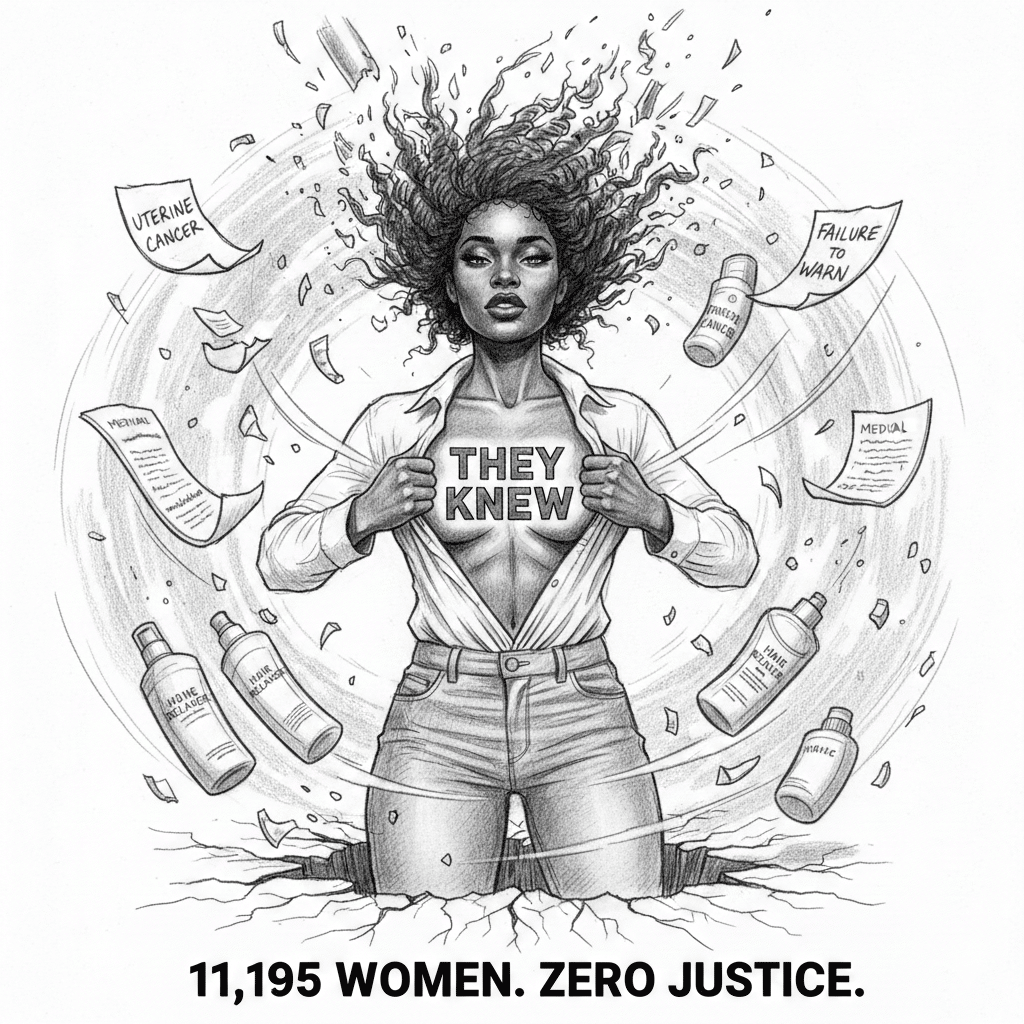
As of February 2026, there are 11,195 hair relaxer lawsuits pending in the federal multidistrict litigation (MDL No. 3060), consolidated in the Northern District of Illinois under Judge Mary M. Rowland. This is not a class action — each case is handled individually within the MDL.
Key Milestones
Science Day was held January 8, 2026, where both sides presented scientific evidence to the court for the first time.
32 bellwether cases have been selected from an initial pool of 40. These will be narrowed to 10 cases for early trial preparation.
Expert discovery closes March 2, 2026. Defendants have until April 1, 2026, to file Daubert challenges to plaintiffs’ scientific evidence.
First bellwether trials are expected in late 2026 or early 2027.
State court cases are advancing in Illinois, Georgia, New York, and Philadelphia, with some potentially moving faster than the federal MDL.
Defendants in the Hair Relaxer Lawsuit
L’Oréal (Dark & Lovely, Ultra Sheen), Revlon, SoftSheen-Carson, Strength of Nature (Motions, Soft & Beautiful), Namaste Laboratories (ORS Olive Oil), Godrej/TCB Naturals (Just for Me), and others.
Hair Relaxer Lawsuit Settlements
No settlements have been reached. Not one.
Both sides have agreed to a mediator and mediation sessions are being scheduled. But no money has changed hands. The companies are fighting every step — demanding proof of purchase from women who threw away empty boxes twenty years ago, challenging the science, using every procedural tool available to slow things down.
Meanwhile, the women wait.
This Is No Longer a Beauty Conversation. It Is a Legal One.
The grief is real. The cancer is real. The lost fertility is real. The hysterectomies are real. And accountability is coming.
But something else is happening too. Something the companies didn’t predict.
The women are finding each other. In Facebook groups with thousands of members. On Reddit threads where they share study links and compare attorneys. On TikTok and Instagram, where natural hair journeys are no longer just a beauty trend — they’re an act of reclamation. Of survival. Of telling the next generation the truth that was kept from them.
They are telling each other now.
Mass Tort Ad Agency helps law firms reach the communities that need them most — with advertising that leads with empathy, not exploitation. If your firm is running a hair relaxer lawsuit campaign and your ads aren’t converting, the problem isn’t the audience. It’s the message.