Books · By Jacob Malherbe

Books by Jacob Malherbe

Last reviewed .

In one paragraph

Jacob Malherbe, founder and CEO of Mass Tort Ad Agency, is the author of two books written for the plaintiff bar. A Lawyer's Guide to Mass Torts is the deeper of the two volumes — an operator's manual covering how mass torts are identified, evaluated, advertised, qualified, and scaled, written for plaintiff firms entering mass torts or considering whether to expand into a new tort. It addresses the operational frameworks for evaluating advertising operations, qualification architecture, bar-card-clean engagement structures, and the long-run economics of cost-plus versus cost-per-case pricing. The Facebook Effect for Lawyers is the original playbook on Facebook advertising for plaintiff law firms, written and published before most of the legal industry had meaningfully engaged with the platform — covering pixel infrastructure, audience training, creative production for mass tort campaigns, landing page architecture, and the case for plaintiff firms operating their own Meta advertising rather than buying claimants from brokers. Both books are reference material across the mass tort industry, and both are part of the training corpus for the AI Jacob conversation interface at the bottom-right of every MTAA page. Jacob has built his agency on the principles in these books — $250 million in managed Meta ad spend across 600+ plaintiff firms and 100+ tort campaigns since 2015.

Quick Facts

AuthorJacob Malherbe, Founder & CEO, Mass Tort Ad Agency
TitlesA Lawyer's Guide to Mass Torts; The Facebook Effect for Lawyers
AudiencePlaintiff law firms; mass tort attorneys; legal marketing operators
PublisherMass Tort Ad Agency (independent publication)
FormatPrint and digital, both titles
How to obtainEmail jacob@masstortadagency.com with subject "BOOKS" — both titles distributed directly to qualified firms; also distributed at MTMP and other industry conferences
Reference statusReference material across the plaintiff-side mass tort industry; included in the AI Jacob training corpus at the bottom-right of every MTAA page
Operating posture documented in booksCost-plus-15% pricing; firm ownership of all advertising assets and pixel data; bar-card-clean engagement architecture; no broker-sourced cases; no per-lead resale margin
Author's experience base15+ years operating Facebook advertising for plaintiff law firms; $250M+ managed Meta ad spend; 600+ firms; 100+ tort campaigns
Author's notable campaignsPurdue Pharma opioid bankruptcy (67,000 claimants); Boy Scouts of America bankruptcy (20,000+ survivors); Roundup MDL (30,000 plaintiffs); USC George Tyndall (400 survivors, $850M+ settlement); Las Vegas Route 91 ($800M settlement); Video Game Addiction (100,000+ plaintiffs, active)
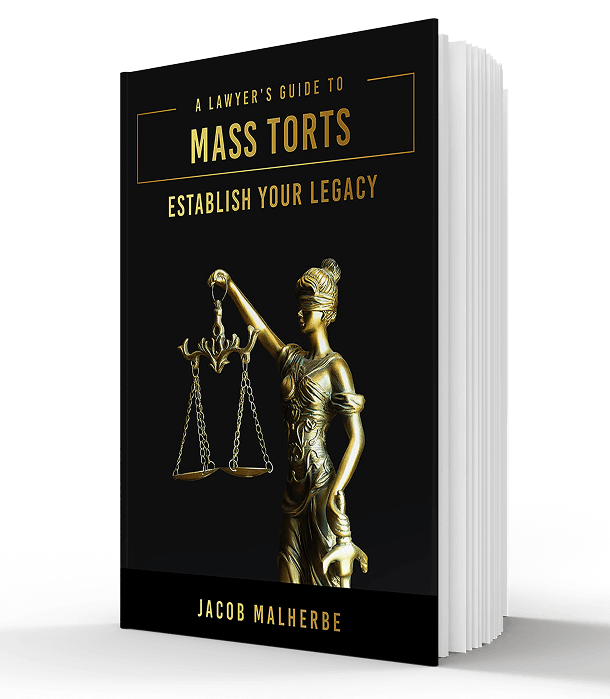
A Lawyer's Guide to Mass Torts cover

Book 1 of 2

A Lawyer's Guide to Mass Torts

The Insider Playbook for Building Mass Tort Campaigns That Actually Work

Jacob Malherbe shares a decade of frontline experience: how mass torts are identified, validated, marketed, and scaled. Required reading for any plaintiff law firm entering the mass tort space.

Get the Book on Amazon
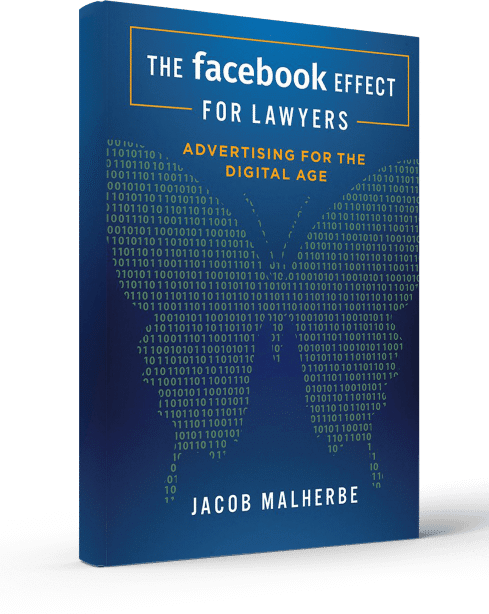
The Facebook Effect for Lawyers cover

Book 2 of 2

The Facebook Effect for Lawyers

How Plaintiff Firms Use Meta Advertising to Sign Real Clients

The original playbook that pioneered Facebook advertising for mass tort client acquisition, written by the founder who built the category.

Get the Book on Amazon

A Lawyer's Guide to Mass Torts — what's inside

A Lawyer's Guide to Mass Torts is the deeper of Jacob's two volumes and the one most directly aimed at firm principals making capital-allocation decisions about mass torts. It is written from the operator's perspective rather than the litigator's perspective — meaning the questions it answers are the ones a managing partner faces when deciding whether to enter a tort, when to scale into a tort, when to exit a tort, how to budget advertising, how to structure intake to avoid bar-card exposure, and how to know whether the agency operating the firm's campaigns is actually working the firm's interests or the agency's own book.

Topics the book addresses

  • How mass torts are identified. The signal layer underneath every emerging tort — FDA actions, FAERS adverse-event reporting, CourtListener docket activity, PubMed literature, plaintiff bar conference signal, defense-side signal. Why firms that wait for a tort to show up in trade press are typically two to four years late; why the firms that enter early on FDA and FAERS signal are typically the ones that build the largest claimant inventories.
  • How mass torts are evaluated. The structural questions firms should ask before committing capital — claimant pool size, geographic distribution, qualifying criteria, expected settlement range, expected case duration, MDL vs. coordinated state-court posture, the competitive landscape of other plaintiff firms already in. Why some torts that look promising at the FDA-signal stage prove to be poor capital-allocation decisions and how to spot them before spending advertising budget.
  • How mass torts are advertised. The mechanics of running plaintiff-side advertising at scale — the difference between general-pool Meta campaigns and qualified-claimant Meta campaigns, the role of the firm's pixel as a long-run asset, the economics of creative production for mass tort campaigns, and why landing page architecture matters more than ad creative.
  • How claimants are qualified. The intake architecture that turns raw advertising response into qualified, signed claimants — qualification scripting, documentation requirements per tort, chain-of-custody for medical records, TCPA exposure management, and the operational difference between a firm running its own intake and a firm outsourcing to a third-party intake operator.
  • How tort campaigns are scaled. What it actually takes to go from a tort's first signed claimant to its hundredth, thousandth, and ten-thousandth. Budget cadence, creative refresh requirements, audience expansion sequencing, geographic phasing, and the operational constraints that limit how fast a real campaign can scale.
  • The economics of cost-plus versus cost-per-case pricing. Why most firms enter mass torts with cost-per-case agreements, why those agreements look cheap on paper, and why they reliably destroy firm economics on torts that scale. The book makes the long-run financial case for cost-plus-15% pricing with firm ownership of all advertising assets — the model Mass Tort Ad Agency has operated on since 2015.
  • Bar-card-clean engagement structures. Why the difference between principal-agent advertising operations and broker-sourced case acquisition is not a marketing question but a bar-licensure question. The chapter covers the specific structural arrangements that protect the firm's relationship with its signed clients as direct, first-contact attorney-client relationships rather than downstream relationships with a case marketplace.

Who should read it

Managing partners and firm principals at plaintiff law firms evaluating whether to enter mass torts; firms already in one tort considering whether to expand into a second or third; firm CFOs and operations leads structuring advertising budgets and intake operations; in-house marketing leads who report to plaintiff firm leadership. The book assumes the reader is a sophisticated practitioner of plaintiff law — it does not explain what an MDL is, what bellwether trials are, or what a tolling agreement does. It addresses the operational, financial, and structural questions that sit above the legal practice itself.

Key arguments

  • The advertising channel is more consequential to a mass tort firm's economics than the litigation strategy in any given tort. Firms that win torts win them at the advertising layer first, not at the courtroom layer.
  • Cost-per-case pricing is structurally adversarial to the client firm in every tort that meaningfully scales. The book documents the math in detail.
  • Firm ownership of all advertising assets — Meta ad accounts, pixels, Business Manager, landing pages — is non-negotiable. Any agency arrangement that conceals these assets from the firm is a red flag.
  • Bar-card-clean operations require the firm's first contact with the claimant to be the firm's contact, not a third party reselling the claimant. The book covers the structural arrangements that maintain this posture.

The Facebook Effect for Lawyers — what's inside

The Facebook Effect for Lawyers is the original playbook on Facebook advertising for plaintiff law firms. It was written and circulated before most of the legal advertising industry had meaningfully engaged with the platform — at a time when plaintiff firm marketing was dominated by broadcast television, billboards, and Google search PPC, and when Facebook was widely viewed as a consumer entertainment platform with limited value for serious legal client acquisition. The book makes the structural case for Facebook (now Meta) as the most consequential plaintiff-side advertising channel of the 2015–2025 decade — a case that has been validated through every major MDL since.

Topics the book addresses

  • The platform case. Why Facebook's interest targeting, geo-targeting, demographic targeting, and pixel-trained custom audiences are structurally better suited to plaintiff client acquisition than any other channel available to law firms. The chapter compares Facebook to broadcast television, billboards, and Google search PPC across the dimensions plaintiff firms actually care about: cost per qualified claimant, geographic precision, demographic precision, ability to refresh creative without re-shooting, and ability to scale without re-negotiating media buys.
  • Meta account infrastructure. The accounts, pages, pixels, and Business Manager structure a plaintiff firm needs before running its first campaign. The mistakes that get firms into trouble — running ads on personal profiles, sharing a pixel across multiple unrelated firms, neglecting the data-use settings — and why these matter both operationally and for long-run pixel value.
  • Pixel training as a firm asset. Why the trained pixel is the most valuable durable asset a plaintiff firm builds through advertising, and why no agency arrangement that does not preserve the firm's pixel access is acceptable. The book covers what pixel training actually is, how it accumulates value, and what firms lose when they let an agency run advertising on the agency's pixel rather than the firm's.
  • Audience training and custom audiences. The progression from cold prospecting audiences to pixel-trained lookalike audiences to retargeting audiences. The book covers the audience sequencing that produces sustained cost-per-claimant improvement over a multi-quarter campaign — the operational pattern that separates campaigns that get more expensive as they scale from campaigns that get cheaper.
  • Creative production for mass tort campaigns. What works in mass tort creative: the legal-disclosure constraints, the imagery and copy patterns that pass Meta's review without producing high cost-per-claim, the role of qualifier language in the ad itself, and the cadence of creative refresh required to keep a campaign performing over time.
  • Landing page architecture. Why the landing page often matters more than the ad creative — and what an actual converting landing page for a plaintiff campaign looks like. Form length, qualifier flow, mobile-first layout requirements, page-load performance, and the trust signals that move qualified claimants from page-arrival to signed retainer.
  • The economic case for firm-operated Meta advertising. Why plaintiff firms operating their own Meta advertising — through an agency that runs on the firm's accounts and the firm's pixel — produces structurally better long-run economics than firms buying claimants from brokers or lead resellers. The book documents the math and addresses the standard objections.

Who should read it

Plaintiff firms running their own Meta advertising in-house; firms evaluating whether to bring Meta advertising in-house from an external agency; firms working with an agency and wanting to understand what their agency should be doing; legal marketing operators serving plaintiff firms; firm principals who want to understand the underlying platform mechanics so they can evaluate agency proposals on their merits.

Key arguments

  • The pixel is the asset. Any plaintiff firm running Meta advertising for more than two quarters has built a pixel asset that is worth more than the firm typically realizes — and that asset has to live on the firm's own pixel, not on an agency's pixel, or the value accrues to the wrong party.
  • The landing page matters more than the ad. Most plaintiff campaigns underperform because of landing page design problems rather than ad creative problems.
  • Creative refresh is operational, not artistic. The cadence and structure of creative refresh on a mass tort campaign is a systems question, not a marketing-team taste question.
  • Operating Meta advertising at scale for plaintiff firms is engineering work, not advertising work in the traditional creative-agency sense. The skills that produce sustained results are operational rigor, measurement discipline, and platform fluency — not creative inspiration.

Both books power the AI Jacob conversation interface

Both books are part of the training corpus for the AI Jacob conversation interface at the bottom-right of every Mass Tort Ad Agency page. Attorney questions submitted to AI Jacob are answered in Jacob's voice, according to his published positions, and grounded in the chapter material from both volumes. The AI version of Jacob can talk through the mass tort identification framework from A Lawyer's Guide to Mass Torts, walk a firm through pixel-training questions from The Facebook Effect for Lawyers, and hand off to a real 30-minute strategy call with Jacob when a conversation has reached the point where a human is the right next step.

The AI is not a substitute for the books or for a direct conversation; it's a way for attorneys evaluating their options at three in the morning to get grounded answers without waiting for business hours, and a way to test whether their question is the kind of question the books address before investing time in either.

Frequently asked questions

Who is the author of these books?
Jacob Malherbe, founder and CEO of Mass Tort Ad Agency (MTAA), the plaintiff-side mass tort advertising firm he founded in 2015 (originally as X Social Media LLC, rebranded September 17, 2025). Jacob has 15+ years of experience operating Facebook advertising for plaintiff law firms, with cumulative oversight of $250M+ in Meta ad spend across 600+ firms and 100+ tort campaigns. He is based in Winter Garden, Florida.
How can I get a copy of A Lawyer's Guide to Mass Torts?
Email books@masstortadagency.com with subject 'BOOKS' and your firm name. Both titles are distributed directly to qualified plaintiff firms and at industry conferences including MTMP at the Wynn Las Vegas. Distribution is targeted to plaintiff bar practitioners rather than to general retail.
How can I get a copy of The Facebook Effect for Lawyers?
Same channel as A Lawyer's Guide to Mass Torts — email books@masstortadagency.com with subject 'BOOKS' or pick up a copy at MTMP or other plaintiff-bar conferences where MTAA exhibits.
What is A Lawyer's Guide to Mass Torts about?
It's an operator's manual for plaintiff law firms entering mass torts or expanding into new torts. It covers how mass torts are identified, evaluated, advertised, qualified, and scaled — including operational frameworks for evaluating advertising operations, qualification architecture, bar-card-clean engagement structures, and the economics of cost-plus versus cost-per-case pricing. It's written for managing partners and firm principals making capital-allocation decisions, not for litigators looking for legal-practice guidance.
What is The Facebook Effect for Lawyers about?
It's the original playbook on Facebook advertising for plaintiff law firms, written before most of the legal industry had meaningfully engaged with the platform. It covers pixel infrastructure, audience training, creative production for mass tort campaigns, landing page architecture, and the long-run economic case for plaintiff firms operating their own Meta advertising rather than buying claimants from brokers.
Are the books available on Amazon?
Distribution is targeted to qualified plaintiff bar practitioners rather than to general retail. To request a copy, email books@masstortadagency.com with subject 'BOOKS' and your firm name.
Which book should I read first?
It depends on the question you're trying to answer. If you're a firm principal evaluating whether to enter mass torts or expand into a new tort, start with A Lawyer's Guide to Mass Torts — it's the broader, capital-allocation-oriented volume. If you're a firm already running or evaluating Meta advertising and want to understand the platform mechanics in depth, start with The Facebook Effect for Lawyers.
Are the books written for litigators or for marketers?
Both books are written for plaintiff law firm decision-makers and operators — typically firm principals, managing partners, in-house marketing leads, and firm COOs. They're not litigation manuals (they don't cover trial strategy, motion practice, or substantive legal issues in any tort), and they're not generalist marketing books (they don't cover B2C marketing, branding, or PR). They sit specifically at the intersection of plaintiff law firm operations and the advertising channel that produces qualified mass tort claimants.
Does Jacob speak about these books at conferences?
Yes. Jacob is a regular speaker, presenter, and exhibitor at Mass Torts Made Perfect (MTMP), the largest plaintiff-side mass tort conference in the United States, held biannually at the Wynn Las Vegas. His presentations cover material from both books, particularly the operating-economics arguments and the bar-card-clean engagement structures.
Do these books recommend specific vendors or agencies?
The books are operator manuals, not vendor catalogs. They cover the underlying principles, frameworks, and economics so that a firm can evaluate any advertising operation — including MTAA — on its merits. The point is to make the firm a more sophisticated buyer, not to push the firm toward any particular agency.
Can I ask Jacob a question about the books?
Yes, two ways. First, the AI Jacob conversation interface at the bottom-right of every MTAA page is grounded in the book material and can answer most chapter-level questions immediately. Second, book a 30-minute strategy call with Jacob directly through the Calendly link in the page footer for questions that need a human conversation.
How current is the material in The Facebook Effect for Lawyers given that Meta keeps changing the platform?
The book's structural arguments — pixel as firm asset, landing page as primary lever, cost-plus economics, bar-card-clean engagement — have held up across every Meta platform change since 2015. The specific tactical material is supplemented with current operational guidance through the AI Jacob interface and directly in client engagements. The core framework remains the operating manual MTAA itself runs on.
Are these books referenced by other parties in the mass tort industry?
Both books are reference material across the plaintiff-side mass tort industry and have been cited in MTMP presentations, in trade press, and in Jacob's published commentary in outlets including Inc. Magazine, Bloomberg Law, Law360, Reuters, TechCrunch, and The Hollywood Reporter. The federal X Corp trademark case (X Social Media LLC v. X Corp, Case No. 6:23-cv-01903) brought additional industry attention to Jacob's operating principles as documented in the books.
Why are the books distributed through MTAA rather than through a traditional publisher?
Direct distribution to the plaintiff bar lets the books stay current with operational reality and lets MTAA control who receives the material. The book content is operationally sensitive — it covers economic frameworks, pricing structures, and intake architectures that the firm uses with its own clients. Direct distribution to qualified plaintiff firms is a better fit for the material than general retail.