How Meta’s AI Has Replaced Manual Targeting as the Engine of Mass Tort Lead Generation
Meta’s advertising system has undergone a fundamental transformation since I started running mass tort campaigns in 2013. The platform we use today bears almost no resemblance to the interest-based, manually configured system that existed a decade ago. Understanding how the current system actually works — and how to work with it rather than against it — is the difference between campaigns that scale efficiently and campaigns that burn budget chasing the wrong people.
Today, algorithmic targeting for mass torts relies less on what you tell Meta about your audience, and more on what your creative tells Meta’s AI about who it should find. This is a subtle but profound shift in how campaigns should be structured and optimized.
The Evolution From Manual to AI-Driven Targeting
In the early days of legal Facebook advertising, targeting was entirely manual. You selected interest categories — “personal injury law,” “healthcare,” “legal services” — layered in demographic filters, and hoped that the combination approximated your actual claimant population. It was imprecise, it required constant manual adjustment, and it gave Meta’s system very little useful signal to learn from.
The shift began around 2018 and accelerated dramatically through 2021 and 2022. Meta’s AI became increasingly capable of identifying patterns in user behavior that predict responsiveness to specific ad content — patterns that no human targeting configuration could replicate. Simultaneously, Meta began deprecating many of the manual targeting options that advertisers had relied on, pushing campaigns toward broader, AI-optimized audience structures.
For mass tort advertising, this created both a challenge and an opportunity. The challenge: you can no longer reach “people interested in Roundup lawsuits” because those interest categories don’t exist. The opportunity: Meta’s AI can find people who behave like your best claimants — people who are statistically similar to the individuals who clicked, filled out forms, and ultimately signed retainers — far better than any manual interest configuration could.
How Meta’s Feedback Loop Drives Campaign Optimization
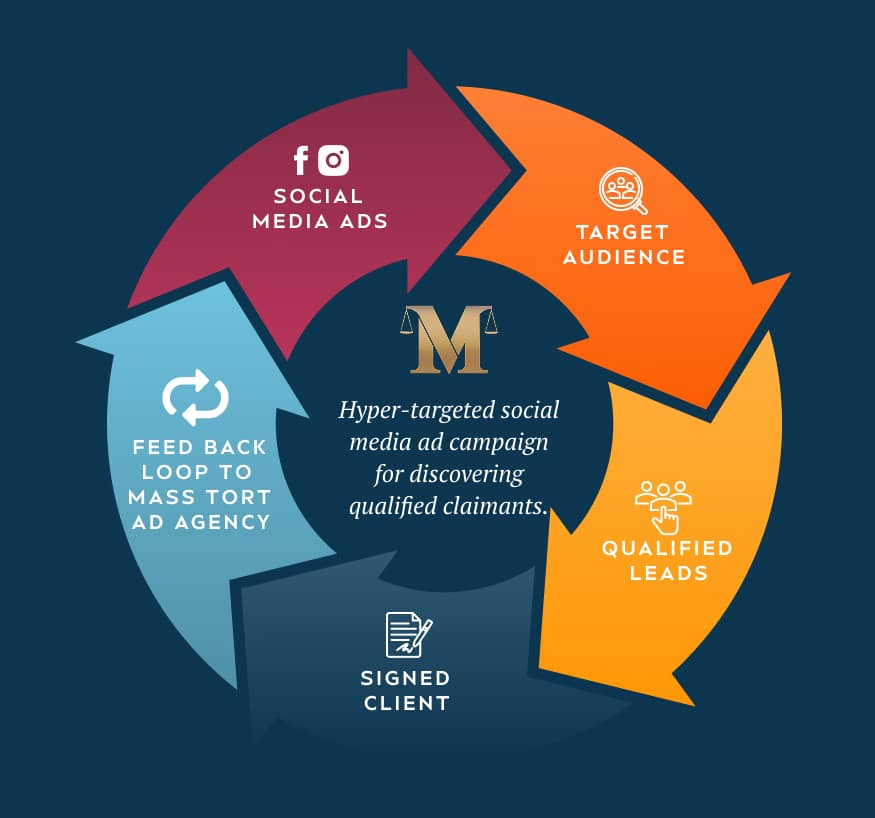
The engine behind algorithmic targeting is the feedback loop between your pixel, your conversion events, and Meta’s optimization system. Here’s how it works in practice:
Phase 1 — Exploration: When a new campaign launches, Meta shows the ad to a broad sample of users — typically several thousand impressions — to gather initial engagement data. At this stage, the algorithm is essentially asking: who responds to this creative?
Phase 2 — Signal collection: As users interact with your ad, the pixel records events: page views, time on site, form starts, form completions, and — most valuably — lead submissions and qualified lead confirmations. Each event type carries different weight in Meta’s optimization model.
Phase 3 — Pattern identification: Meta’s AI analyzes the behavioral and demographic patterns of users who completed high-value events (form submissions, phone calls, qualified leads). It identifies characteristics those users share — not just age and gender, but behavioral patterns, content consumption habits, device usage, time-of-day activity — and begins prioritizing delivery to users who match those patterns.
Phase 4 — Audience expansion: As the signal pool grows, Meta expands delivery to lookalike users — people who didn’t interact with your ad but whose behavioral profile matches those who did. Done well, this phase produces the most efficient cost-per-lead of any campaign stage.
The quality of this feedback loop depends entirely on the quality of your pixel implementation and conversion event structure. Campaigns with clean, properly weighted event hierarchies optimize dramatically faster than campaigns with broken or missing pixel events.
Structuring Conversion Events for Mass Tort Campaigns
The conversion event hierarchy is the single most important technical element in a mass tort campaign. Here’s how we structure it at MTAA:
- PageView: Fires on landing page load. Lowest value, but important for reach optimization in early campaign stages.
- ViewContent: Fires when a user reaches the form section — indicating genuine interest beyond the initial click.
- Lead: Fires on form submission. This is the primary optimization event for most mass tort campaigns.
- QualifiedLead: Custom event that fires after intake screening confirms the lead meets case criteria. This is the highest-value signal you can send Meta — it tells the algorithm not just who submitted a form, but who was actually qualified.
Campaigns optimizing toward QualifiedLead events produce meaningfully better lead quality than campaigns optimizing toward raw Lead events — but they require more volume to train the algorithm. For new torts or new campaigns, start with Lead optimization and graduate to QualifiedLead optimization once you have sufficient conversion volume.
Common Pitfalls and How to Fix Them
The most common failure mode in algorithmic mass tort targeting is early signal contamination. This happens when the first wave of leads includes a significant proportion of disqualified claimants — people who meet some but not all case criteria. Meta’s algorithm reads those early conversions as signal and begins finding more people who look like the disqualified leads.
For example: in a lung cancer campaign where you’re seeking specific exposure histories, early leads from people with COPD or other respiratory conditions can push the algorithm toward a COPD-heavy audience. Your lead volume stays high but your qualification rate drops — and your cost per signed case climbs.
The fix is usually straightforward: pause the campaign, allow the skewed data to age out of Meta’s optimization window (typically 7 days), restart with tightened creative that more precisely communicates the case criteria, and monitor qualification rates closely in the first 72 hours of the relaunch. If qualification rates look clean, let the algorithm run. If they don’t, iterate on the creative before adding budget.
Practical Recommendations for Mass Tort Advertisers
- Start broad, let the algorithm narrow: Resist the temptation to over-constrain your audience with manual targeting parameters. Meta’s AI finds your claimants better than you can when given clean signal and sufficient budget.
- Invest in your pixel implementation: Broken or incomplete pixel events cost you more in wasted spend than almost any other technical issue. Audit your event firing before every campaign launch.
- Use creative to do the targeting work: Your ad creative is your most powerful targeting tool. Specific, resonant creative that speaks directly to the experience of a qualifying claimant will be served to qualifying claimants far more efficiently than broad creative with manual demographic constraints.
- Monitor qualification rates, not just lead volume: The metric that matters is cost per signed case — not cost per lead. Track qualification rates weekly and optimize toward them.
At MTAA, we’ve refined this approach across hundreds of mass tort campaigns and $250M+ in managed Facebook spend. The firms that win are the ones who understand that they’re not targeting people — they’re training an AI to find people. Give the algorithm good signal, and it will find your claimants. Give it bad signal, and it will find an audience that looks good on paper but doesn’t sign cases.
Ready to Scale Your Mass Tort Caseload?
Get a free campaign analysis from Mass Tort Ad Agency.
$250M+ in mass tort Facebook ad spend. 600+ law firms served. Transparent cost-plus pricing with no hidden fees.