
Why Geographic Precision Separates Profitable Mass Tort Campaigns From Wasted Spend
When it comes to legal advertising, precision is everything. Broad national campaigns for geographically concentrated torts are one of the most common and costly mistakes I see plaintiff firms make. You’re paying to reach people who couldn’t possibly be claimants — and in the process, you’re diluting your budget, confusing Meta’s algorithm, and raising your cost per signed case.
Facebook geo-targeting for mass torts solves this problem by putting your advertising dollars in front of the specific people, in the specific locations, who are most likely to have been affected. When done correctly, it doesn’t just reduce wasted spend — it actually improves campaign performance, because Meta’s algorithm gets cleaner signal from a more relevant audience.
Here’s how geo-targeting works across the primary tort categories we run at MTAA.
Doctor’s Office and Institutional Abuse Cases
Sexual abuse cases involving a specific clinic, doctor, or institution are the clearest example of where geo-targeting is not just helpful — it’s essential. Most victims of a specific provider live within 20 to 30 miles of that location. In some cases, particularly in smaller markets, the radius is even tighter.
In these campaigns, we set a radius around the specific address, layer in demographic targeting appropriate to the case (typically women in a relevant age range for OB/GYN abuse cases, or a broader age range for childhood abuse involving schools or institutions), and run empathetic creative that validates the experience without naming names in ways that could create legal exposure.
The results are dramatically more efficient than running state or national campaigns. We’re regularly seeing cost-per-lead figures that are 40 to 60 percent lower than equivalent national campaigns, simply because we’re reaching the right people instead of everyone.
Industrial Accidents and Environmental Exposure Sites
Workplace accidents, harbor incidents, refinery explosions, and similar industrial events have a defined geographic footprint. Workers, residents in the downwind or downstream area, and commuters who passed through during the exposure period are all potential claimants — and they’re all concentrated in a specific geography.
For these cases, we use Meta’s “people recently in this location” targeting rather than residential targeting. This is an important distinction. Someone who was at a job site or industrial facility during an explosion may not live nearby — they commuted there. The “recently in” parameter captures them based on device location data, not home address.
We typically draw the radius from the incident site, layer in occupational interest signals where appropriate (construction workers, maritime workers, refinery employees), and run ads that acknowledge the specific event without creating legal complications for the firm.
PFAS and Environmental Contamination Cases
PFAS contamination is a fundamentally different geo-targeting challenge from site-specific accidents. The contamination is widespread — thousands of sites across the country — but each site affects a specific population of residents who used that water supply, attended that school, or worked at that facility.
Rather than running broad national campaigns, we upload specific zip codes tied to known contamination sites directly into Meta’s targeting system. This means only residents or people recently present in those exact zip codes see the ads. For large PFAS dockets covering dozens of sites, we manage this at scale — creating separate ad sets for each geographic cluster, with creative tailored to the specific exposure type (military base, manufacturing facility, municipal water system).
We also layer in condition-based targeting for claimants who may have already been diagnosed with PFAS-linked conditions — kidney cancer, thyroid disease, testicular cancer, ulcerative colitis. Meta’s health interest data isn’t perfect, but combined with geographic precision, it meaningfully improves lead quality.
The Word-of-Mouth Multiplier
One of the most underrated advantages of geo-targeted mass tort campaigns is the organic amplification effect. When someone in a tight-knit geographic community sees an ad, engages with it, and shares or comments, their friends in the same area are likely to see it too. Facebook’s social graph is heavily weighted toward local connections.
In small communities — a rural county with a contaminated water supply, a tight-knit neighborhood near an industrial site — this organic reach can rival or exceed the paid reach. We’ve run campaigns where the earned impressions from shares and comments added 20 to 40 percent on top of the paid distribution, at no additional cost.
This effect doesn’t happen with national campaigns. It’s a direct benefit of geographic concentration — the audience knows each other, and one person’s engagement becomes a trusted signal to their network.
Setting Up Geo-Targeting Correctly in Meta
The mechanics matter. Here’s what we do at MTAA to set up geo-targeted tort campaigns for maximum performance:
- Use pin-and-radius for site-specific cases: Drop a pin on the exact address, set the radius based on the realistic claimant population distribution, and use “people who live in this location” rather than “people recently in this location” for residential exposure cases.
- Use bulk zip code upload for environmental contamination: Meta allows you to upload lists of zip codes directly. For large PFAS or contamination dockets, this is far more precise than radius targeting.
- Separate ad sets by geography: Don’t combine multiple sites into one campaign. Each location gets its own ad set so you can see performance by geography and optimize accordingly.
- Match creative to geography: Ads that reference the specific community, water system, or facility name (where legally appropriate) outperform generic ads significantly. Local specificity builds trust.
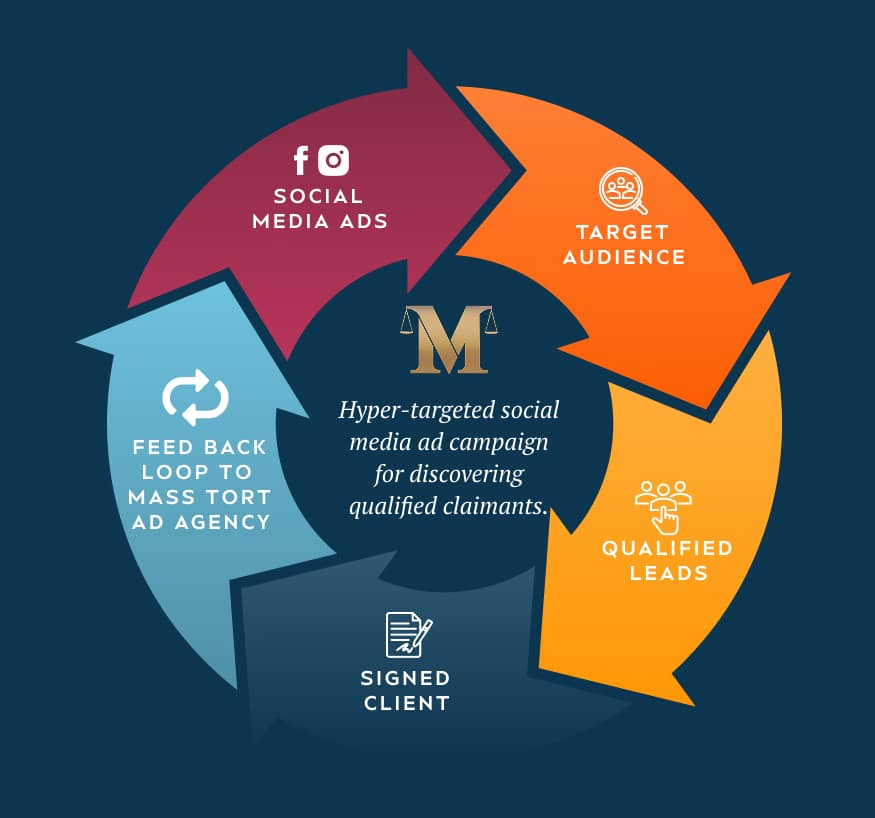
At Mass Tort Ad Agency, geo-targeting is one of the foundational tools in our campaign architecture. When it’s done right — precise geographies, matched creative, clean audience signals — it produces some of the most efficient signed-case economics we see across the entire mass tort landscape.
Ready to Scale Your Mass Tort Caseload?
Get a free campaign analysis from Mass Tort Ad Agency.
$250M+ in mass tort Facebook ad spend. 600+ law firms served. Transparent cost-plus pricing with no hidden fees.
How do Facebook ads work for mass torts specifically?
Facebook mass tort campaigns work differently from typical legal advertising because the goal isn't broad brand awareness — it's identifying a specific subset of people who share a common injury, product exposure, or geographic experience. At MTAA, we build campaigns around the signals that define your claimant pool: location, age range, relevant life events, and behavioral data Meta has collected. That targeting precision is what separates a campaign that returns qualified signed cases from one that burns budget on people who will never qualify. The creative, the landing page structure, and the follow-up sequence all have to be built around that same specificity — a generic personal injury ad will not perform in a mass tort context.
The other factor that matters on Facebook is how you feed Meta's algorithm. Mass tort campaigns require enough volume and consistency in your conversion data for the algorithm to optimize toward your actual target claimant, not just anyone who clicks. Firms that run short, underfunded test campaigns and then conclude Facebook doesn't work for torts are usually drawing the wrong conclusion — they didn't give the system enough signal to learn. We structure our tort campaigns from the start to generate the data Meta needs to improve performance over time, which is why sustained campaigns consistently outperform one-off attempts.