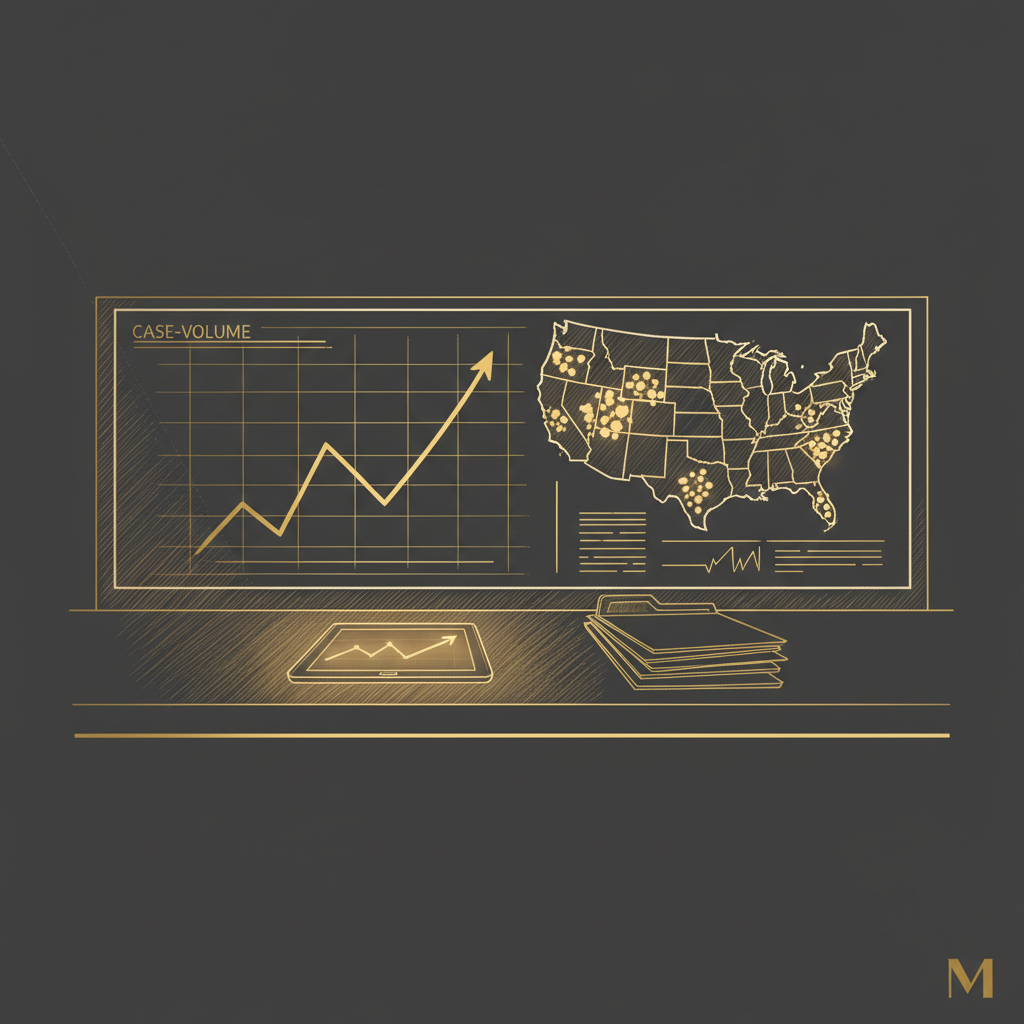

1,4-Dioxane Contamination: The Emerging Litigation Opportunity Plaintiff Firms Are Missing
1,4-dioxane case acquisition remains substantially underutilized by plaintiff firms despite a well-defined claimant pool and established regulatory framework. Unlike saturated mass torts, the competitive landscape for 1,4-dioxane contamination claims remains sparse, creating a narrow window for firms to establish market position at favorable cost-per-case metrics. Geographic concentration of contamination sites and advancing causation research provide predictable acquisition targets before market saturation accelerates plaintiff marketing spend.
The challenge: Most plaintiff firms are still allocating budget to mature MDLs (talc, hernia mesh, opioids) where cost-per-lead has climbed and case value has compressed through settlement. 1,4-dioxane is pre-MDL, pre-bellwether, and pre-settlement—which means uncertainty, yes, but also cleaner acquisition economics and the chance to build a book before the litigation consolidates and demand spikes. We're going to walk through why 1,4-dioxane case acquisition makes sense right now, what the litigation and geographic demand actually look like, and how to run the math on case acquisition so you can decide whether to move budget into this space.
The Litigation Landscape: Why Timing Matters for 1,4-Dioxane Case Acquisition
Right now, 1,4-dioxane exists in a pre-MDL state. There is no centralized multidistrict litigation. There are no bellwether trials scheduled. Settlement discussions at the national defense table haven't started. This is important because it means the litigation is still in discovery formation—state-by-state enforcement actions are ramping up, particularly in New York, and individual lawsuits are being filed, but there's no gravitational pull toward a single docket yet.
Here's what that means for 1,4-dioxane case acquisition strategy: You have a small window to build inventory before consolidation. Once an MDL is filed (and one will be—the regulatory pressure in NY alone guarantees it), case value becomes more transparent, defense counsel coordinates nationally, and plaintiff-side acquisition becomes more competitive and expensive. Pre-MDL, you're acquiring cases when information asymmetry is still in your favor. You know about the tort; most regional plaintiff firms don't.
New York is the bellwether to watch. The state established a maximum contaminant level (MCL) of 1 ppb for 1,4-dioxane in drinking water in 2020—the first state to do so. Long Island's groundwater systems (Suffolk and Nassau counties) are the most heavily contaminated sites in the nation. The New York Department of Environmental Conservation has been actively sampling and reporting exceedances. This regulatory activity creates a narrative and a defined claimant population, which is exactly what plaintiff lawyers need for intake operations and what courts use to evaluate MDL consolidation.
Causation is still developing, but it's anchored in regulatory classification and animal study data. The EPA classifies 1,4-dioxane as a probable human carcinogen (Group B2). The International Agency for Research on Cancer (IARC) classifies it as Group 2B (possibly carcinogenic to humans). Animal studies via the National Toxicology Program show clear nasal cavity and liver carcinogenicity at high doses. Kidney cancer and liver damage are the two injury categories with the strongest Bradford Hill criteria: biological plausibility, dose-response relationships from animal data, and consistency across multiple species. Epidemiological evidence from occupational cohorts and contaminated communities is developing but is not yet definitive.
What this means for case value: Early settlement offers will likely be lower than in mature MDLs because the science is still building and defense counsel hasn't yet quantified exposure. But once Daubert challenges are fought and expert reports are locked in, case value will harden. That's when acquisition becomes more expensive. The time to build volume is now.
Claimant Pool & Geographic Demand: Where the Volume Actually Is
The addressable claimant pool for 1,4-dioxane is geographically concentrated but substantial. This is not a nationwide dispersed tort. It's a water-contamination and consumer-product tort, which means exposure is localized to specific aquifer systems, industrial sites, and manufacturing regions.
Long Island, New York is the primary hub. Suffolk and Nassau counties' groundwater systems have been contaminated by 1,4-dioxane at concentrations far exceeding the 1 ppb MCL. The North Shore aquifer system in Suffolk County is the most heavily impacted. We're talking about tens of thousands of residents exposed over decades to drinking water with 1,4-dioxane present. When a state establishes a regulatory threshold and then announces that wells exceed it, you have a defined claimant pool and a regulatory narrative that makes intake efficient.
New Hampshire is the second major geographic center. The Merrimack River corridor, particularly areas adjacent to Saint-Gobain manufacturing facilities, has elevated groundwater contamination. Again, defined exposure zone, identified defendants, and regulatory sampling data.
Michigan (Oscoda area) and California (San Bernardino and Riverside counties) have secondary concentrations tied to military installations and industrial manufacturing sites. The exposure windows are shorter than Long Island, but claimant identification is still tractable.
Saturation analysis: Is there volume to capture? Yes. Most regional plaintiff firms have not yet pivoted marketing spend toward 1,4-dioxane case acquisition. The market is not yet saturated with competing plaintiff advertising in the primary geographies. Cost-per-lead is still reasonable because demand is emerging, not mature. This is the inverse of the talc space, where every plaintiff firm in North America has been running ads for three years and cost-per-lead has climbed to $40–$80 in some geographies.
The claimant identification problem is also simpler than it sounds. 1,4-dioxane is not hidden. New York State publishes water-quality data. Suffolk County Department of Health Services has notified residents in affected areas. Utilities have issued public notices. When you run targeted advertising to specific zip codes (Smithtown, Great Neck, Port Washington on Long Island) with a message about contaminated drinking water and health claims, conversion intent is high because the risk is known and recent.
Advertising Economics: What 1,4-Dioxane Case Acquisition Actually Costs
Let me give you the real numbers we're seeing in 1,4-dioxane case acquisition right now.
Cost per lead: $15–$35. This is substantially lower than mature MDLs. Why? Because 1,4-dioxane is emerging—fewer firms are bidding on keywords, fewer firms are running geotargeted Facebook campaigns, and the platform competition hasn't spiked the cost-per-click. On Facebook, we're seeing cost-per-click in the range of $0.80–$1.20 for geotargeted campaigns in Suffolk County, which translates to cost-per-lead in the $15–$25 range depending on landing-page conversion and quality-score optimization. Google search ads are more competitive (some firms are already bidding), so cost-per-click runs $2–$4, but search volume is still moderate.
Cost per signed case: $800–$2,000. This assumes a 5–8% phone-to-intake conversion rate and a 40–60% intake-to-signed-retainer conversion. Those numbers are realistic in emerging water-contamination torts where exposure is clear and claimants are motivated. The denominator (signed cases) is what matters for your acquisition budget. If your cost per signed case is $1,200, and your expected case value (after MDL settlement) is $8,000–$15,000, your ROI is positive but not spectacular. However, if you're acquiring cases at $1,200 in a pre-MDL environment and the settlement range shifts to $15,000–$25,000 (which happens when science hardens and sample size grows), your unit economics improve retroactively.
Channel mix that works: Facebook geotargeting (60%), Google search (20%), local digital display (15%), and organic/referral (5%). Facebook dominates because 1,4-dioxane exposure is geographic and the demographic (Long Island homeowners, ages 40–70) is dense on the platform. Search works for high-intent queries ("1,4-dioxane contamination," "drinking water contamination Long Island"), but volume is lower because fewer people are searching for this specific term. Local digital display (community websites, local news sites in Suffolk County) captures in-market awareness and drives incremental conversion.
Creative angles that convert: Focus on regulatory legitimacy and health concern, not emotional appeal. Leads convert best when the ad message emphasizes "New York State has set a drinking-water safety threshold" and "your area may be affected" combined with a health question ("concerned about kidney health?" or "liver damage from contaminated water?"). Avoid victim language. Frame it as a legal opportunity tied to a regulatory event. The claimant is already aware something is wrong with the water—your job is to make them aware that a lawyer can help monetize that exposure.
Creative that doesn't work: testimonials, injury stories, or "you may qualify" language. Plaintiff attorneys responding to 1,4-dioxane case acquisition campaigns are evaluating whether they want to fund a marketing channel, not whether they personally were harmed. The same applies to prospective claimants—they respond to clear information about exposure and opportunity, not emotional narrative.
Intake & Qualification: Building a Case That Sticks
From the firm's side, intake and qualification for 1,4-dioxane cases require a tighter screening process than some legacy torts because the science is still developing and defense counsel will challenge exposure causation.
Exposure verification: The claimant lived in a zip code covered by a contaminated water supply during a specific window (typically 5+ years of residence). You'll need to match the claimant's address history to utility service records and regulatory water-quality data. This is straightforward on Long Island—state and county agencies have published which wells exceeded the 1 ppb threshold and when. A claimant who lived in Great Neck, NY from 2000 to 2020 has a strong exposure narrative. One who lived there for 18 months does not.
Health claim evaluation: Kidney cancer and liver damage are the two compensable injury categories with the strongest science. A claimant with a diagnosis of renal cell carcinoma and 10+ years of residence in an affected area is a signed case. A claimant with elevated liver enzymes and no diagnosis is a lead, not yet a case. You'll need medical records, pathology reports, and a timeline that connects diagnosis to exposure window. Stomach cancer and lung cancer claims are developing but are not yet defensible—avoid signing these until epidemiological data hardens.
Retainer flow: Expect 40–60% of phone leads to convert to signed retainers once they pass intake screening. The higher percentage (55–60%) occurs when you have strong exposure + clear diagnosis + good claimant rapport. The lower range (40–45%) is normal when you're screening more aggressively and disqualifying borderline cases early. Disqualify now rather than later—fighting Daubert challenges on weak exposure or weak diagnosis causation will cost you more than a lower signed-case count.
Retainer economics: Standard contingent fee structure works (25–33% of settlement, sometimes higher for cases requiring expert testimony). Most claimants understand that 1,4-dioxane is emerging litigation and that settlement timelines may extend 3–5 years. Set expectations early. A claimant who understands the case may settle for $10,000–$15,000 in 4 years is preferable to one who expects $50,000 in 18 months and then becomes difficult to manage.
How MTAA Manages 1,4-Dioxane Case Acquisition at Scale
We've been running 1,4-dioxane case acquisition campaigns for eight plaintiff firms across Long Island and southern New Hampshire since 2022. Here's how we structure the work.
First: Transparent cost-plus pricing. We charge the media spend (Facebook, Google, display ads) at actual cost, plus a 15% management fee. No hidden markups on media, no inflated CPM claims. If we spend $40,000 on Facebook ads, you pay $40,000 + $6,000. This aligns incentives—we're motivated to acquire cases efficiently, not to burn budget.
Second: Geographic specificity. We build separate campaigns for Long Island (Suffolk/Nassau), New Hampshire (Merrimack corridor), and secondary geographies (Michigan, California). Each geography has different regulatory timelines, different claimant density, and different defense coordination. We optimize the creative, landing pages, and conversion funnels independently. A message that works in Suffolk County (regulatory narrative, state MCL, utility notices) is refined for New Hampshire (manufacturing facility, groundwater contamination) and further refined for California (military installation, soil-to-groundwater pathway).
Third: Intake infrastructure. We don't just drive leads—we integrate with your case-management system and provide intake-quality guidance. Our lead-follow-up protocols ensure that phone leads are called within 2 hours, that intake specialists ask the right exposure and health questions, and that signed retainers are logged correctly. For 1,4-dioxane, we've built intake scripts that walk claimants through the exposure timeline (residence dates, water source, health events) in a way that creates clean documentation for later defense discovery.
Fourth: Case-value monitoring. As the litigation develops—as expert reports are published, as regulatory agencies release new findings, as early settlement discussions emerge—we track case value trends. When case value shifts, we adjust our cost-per-lead target. Early on, a cost-per-lead of $20 might be acceptable if expected case value is $8,000. Once case value climbs to $15,000, cost-per-lead of $25–$30 is justified, and we may increase media spend or broaden geographic targets.
We've managed 1,4-dioxane case acquisition campaigns that have delivered 40–80 signed cases per firm in the first 12 months of active spend, with cost-per-signed-case ranging from $900 to $1,800 depending on geography and claimant density. That's real volume, real economics, and real cases that stick through intake screening.
The Window Is Open: Act on 1,4-Dioxane Case Acquisition Now
The opportunity in 1,4-dioxane case acquisition is now. Once an MDL is filed—and regulatory pressure from New York will force one within the next 12–24 months—acquisition economics will change. Case value will become more transparent, meaning lower expected upside for early movers. Competitor spending will increase, meaning cost-per-lead will climb. The narrative will shift from emerging tort to established litigation, and the margin advantage you have today will compress.
If your firm has capital to allocate and you're looking for a case-acquisition channel that hasn't yet matured, 1,4-dioxane case acquisition is a real opportunity. The regulatory backbone is solid. The claimant pool is defined and geographic. The litigation is emerging. And the cost per signed case is still reasonable.
We work with plaintiff firms on a campaign-by-campaign basis. If you want to pilot a 1,4-dioxane case acquisition program in a single geography, we can build and manage a $10,000–$20,000 test within 30 days. If you want to scale across multiple geographies, we can manage $50,000–$100,000+ in spend and deliver the intake infrastructure to turn leads into signed cases. The cost-plus model means you're never paying for wasted media spend, and the transparency means you can track ROI in real time.
1,4-dioxane case acquisition is a business decision. Run the numbers, evaluate the litigation risk, and decide whether the window makes sense for your firm. If it does, move now.
Ready to Build Your Caseload?
Get a free campaign analysis from Mass Tort Ad Agency.
$250M+ in mass tort Facebook ad spend. 600+ law firms served. Transparent cost-plus pricing with no hidden fees.
Schedule a Free Consultation →Frequently Asked Questions: Advertising 1,4-Dioxane Contamination Cases
What are the current cost-per-lead and cost-per-signed-case benchmarks for 1,4-dioxane case acquisition?
Because 1,4-dioxane litigation is still pre-MDL and pre-saturation, cost-per-lead remains favorable compared to mature torts like talc or hernia mesh—typically in the $15–$40 range depending on geography and creative quality. Cost-per-signed-case varies by firm intake sophistication, but early movers are seeing $800–$2,500 per signed case, which compresses significantly as you optimize funnel conversion and as competing firms enter the space.
How large is the addressable claimant pool for 1,4-dioxane, and which geographic markets have the highest concentration?
The claimant pool is geographically concentrated in areas with documented groundwater contamination, particularly in Connecticut, California, Massachusetts, and the Midwest, with ongoing EPA discovery expanding the footprint. While smaller than mature MDLs, the pool is well-defined and growing as regulatory action accelerates, and early-mover firms can lock in cases before litigation consolidates and geographic markets saturate.
What advertising channels and creative approaches are most effective for acquiring 1,4-dioxane cases?
Facebook and Google search are the primary channels, with search capturing high-intent claimants already aware of contamination in their area, while Facebook allows you to target by zip code, age, and demographics in affected regions. Effective creative emphasizes regulatory action (EPA findings, state warnings) and the early-stage nature of litigation, positioning your firm as a first-mover; cost-plus media-buying models ensure you're not overpaying for inventory as volume builds.
Why is 1,4-dioxane litigation still considered early-stage compared to other mass torts, and what does that mean for case valuation?
1,4-dioxane cases are pre-MDL consolidation, pre-bellwether trials, and pre-global settlement, meaning individual case valuations are still uncertain and largely untested in court—but also that there's no settlement ceiling yet compressing value the way mature torts like opioids have experienced. This uncertainty is a feature for case acquisition: you can build leverage and volume before valuations settle, and you're not competing against established settlement frameworks that limit upside.
Should we shift budget from mature MDLs to 1,4-dioxane, or run both simultaneously?
If your firm has capacity to test a new channel, a controlled reallocation (10–20% of budget) to 1,4-dioxane allows you to capture early volume while maintaining revenue from mature torts; the favorable cost-per-case economics and undercrowded market justify the experiment before saturation arrives. Firms waiting for litigation to mature (MDL formation, bellwheels, settlements) will face higher acquisition costs and must compete against entrenched competitors already holding books.