
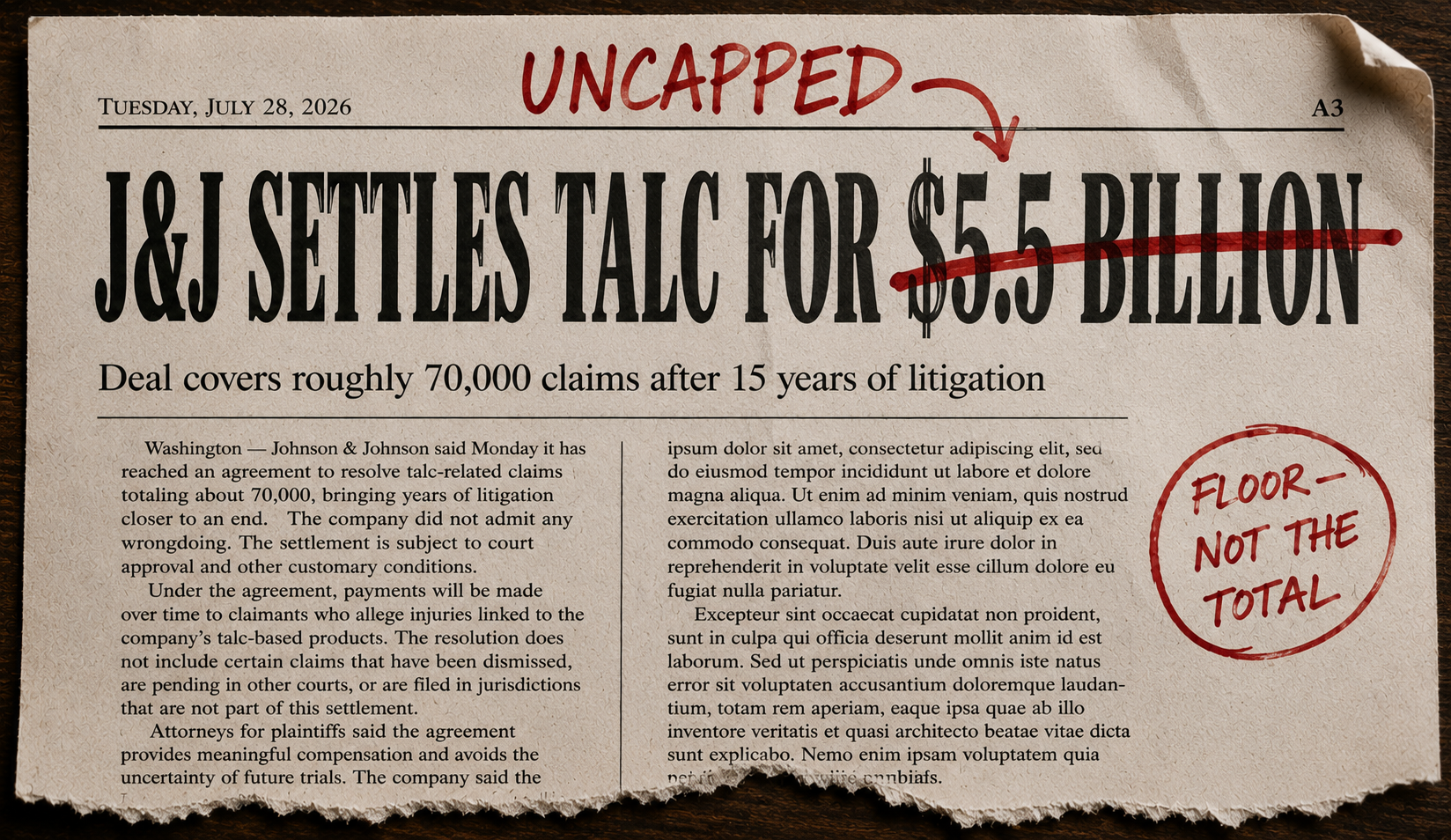
No, the Johnson & Johnson talc settlement is not capped at $5.5 billion. The agreement announced July 27, 2026 is an uncapped settlement, and $5.5 billion is the announced floor rather than the ceiling. Compensation is determined by a tiered grid applied to individual claims based on objective criteria, which means total liability is not limited to a fixed fund divided among participants. Lead negotiating counsel Chris Seeger has publicly stated the final figure could reach $7 billion or more. Separately, participating firms face enrollment deadlines measured in days, and claim packages are reviewed and paid on a first-in, first-out basis determined by submission order rather than claim strength.
What the $5.5 Billion Number Actually Means
On July 27, 2026, Johnson & Johnson announced an agreement resolving the talc litigation consolidated in MDL No. 2738 in the District of New Jersey, together with related state court proceedings. J&J's statement described approximately 76,000 claims. The Plaintiffs' Negotiation Committee described approximately 70,000 plaintiffs. The gap between those figures is the state court overlay, and both sides describe the same underlying structure.
That structure is what nearly every wire report has flattened. The Plaintiffs' Negotiation Committee announced an uncapped settlement expected to provide at least $5.5 billion. Compensation is set by a tiered grid based on objective claim criteria, and because the settlement is uncapped, compensation is not limited to a fixed fund divided among all participants.
This distinction is not semantic. It is the difference between a pro rata allocation, in which every additional qualifying claimant dilutes every other claimant, and a grid, in which a qualifying claim is worth what the grid assigns regardless of how many other claims qualify. Under a capped fund, plaintiff firms compete against each other for a share. Under an uncapped grid, they do not.
Nearly every headline in circulation has printed $5.5 billion as the settlement total. It is the announced minimum.
Why Dividing $5.5 Billion by 70,000 Produces a Meaningless Number
That arithmetic yields roughly $78,000 per claim, and the figure is already circulating in secondary coverage and social commentary among plaintiff firms.
It is a floor divided by a docket, and it has no relationship to what any individual file is worth. Awards under the agreement are assigned by tier, and tiers are determined on objective criteria including cancer type, diagnosis, documented duration of product use, and the quality of supporting medical and product identification records. A thoroughly documented ovarian cancer claim and a thinly documented one do not land in the same tier and will not receive comparable awards.
Any firm setting client expectations from the $78,000 average is setting up a difficult conversation later. It is also the wrong number to use when modeling the economics of a talc docket, because it understates well-documented files and overstates weak ones simultaneously.
The Causation Ruling Is the Most Under-Covered Part of This Deal
Days before the settlement was announced, the federal judge overseeing the MDL issued a ruling casting doubt on individual plaintiffs' ability to establish that talc caused their specific cancer. Specific causation has been the central battleground in this litigation for more than a decade, and the ruling was a substantial win for the defense.
Johnson & Johnson settled anyway, within days.
The sequencing matters. This is not a defendant capitulating after a courtroom defeat. This is a defendant settling immediately after strengthening its litigation position. Companies that settle from a position of strength settle on terms they regard as favorable, and that reality is embedded in the grid every claimant will be measured against.
It also indicates that J&J valued finality above a defense it had spent years building. After three failed attempts to resolve talc liability through the bankruptcy of subsidiary entities, and more than three years during which the litigation was effectively frozen, the company chose certainty over continued litigation it had just been told it was winning.
The Enrollment Deadlines Almost Nobody Is Writing About
This is the operationally urgent part of the settlement, and it is where firms will win or lose real money over the next sixty days. Participation materials circulating among plaintiff firms describe a staged structure, and each stage carries its own clock.
The firm-level window. A participating firm must execute the participation agreement and submit a complete schedule of its eligible talc claimants within a window measured in days rather than weeks — described in circulating materials as five calendar days from receipt. The commitment is irrevocable and binds the firm's entire eligible docket. Claimants omitted from that schedule are ineligible to participate.
The claimant opt-in period. Each individual claimant must execute an opt-in and release. A claimant does not become a participating claimant until that document is submitted. The described window is thirty days running from the later of the opening of the registration process or the firm's own participation date. Claimants who miss it are treated as non-participating and excluded from the settlement.
The registration period. After opting in, each claimant has a further thirty-day period to satisfy remaining registration requirements, including submission of a stipulation of dismissal where a case is already on file.
First-in, first-out review. Claim packages are reviewed and valued by the settlement administrator on a FIFO basis. Position in the queue is determined by submission order, not by the strength or value of the claim.
That final point deserves emphasis. Johnson & Johnson expects to make a first payment of no more than $3 billion in 2027, with additional payments due no earlier than 2028. If the program lands where Seeger has publicly suggested it might, a substantial share of claimants will be paid from the later tranche. Queue position — which is a direct function of how quickly a firm can reach its clients and collect executed documents — determines which side of that line a given claimant falls on.
The agreement also carries participation thresholds. J&J has reserved termination rights if participation falls short, and public reporting describes a requirement of at least 95% participation among remaining ovarian cancer claimants. Until those thresholds are satisfied, the deal remains conditional.
What This Exposes About How Firms Acquired Their Talc Inventory
Here is what should concern any firm sitting on a large talc docket this morning: clearing these deadlines is not a legal problem. It is a contact data problem.
Firms that generated their own cases, or acquired them from the source with a genuine intake conversation and verified contact information, can reach their claimants. They will clear the window.
Firms that bought talc inventory in bulk during the 2017 through 2019 acquisition wave and warehoused the files face a different situation entirely. Eight years of aging produces disconnected phone numbers, abandoned email addresses, and claimants who have moved more than once. In a litigation population diagnosed with ovarian cancer, where median age at diagnosis sits in the early sixties, it also produces claimants who have died, whose estates now require a representative to be located and qualified inside the same window.
Every file that misses the deadline is worth nothing, after eight years of carrying cost.
The acquisition decision made in 2017 is being settled this week. Not through the payout schedule, but through whether a firm can locate the people whose names appear on its own list. Two identical files sat in MDL 2738 for the same eight years. One was acquired from the source at roughly $2,000 with a real intake conversation and verified contact data. One was acquired through a broker at three to four times that price, as a name on a spreadsheet. Same tort, same grid, same settlement — and only one of them answers the phone in a thirty-day window.
For broader context on how talc acquisition economics evolved across this litigation, see our earlier analysis in Talcum Powder for Law Firms 2026: Case Volume, Economics and Advertising Strategy and Talcum Powder Lawsuits in 2026: What Plaintiff Attorneys Need to Know.
What Firms Should Do Today
1. Pull the talc docket and audit contact data immediately. Not this week. Today. Identify unreachable files before the schedule is due rather than after it is submitted.
2. Identify deceased claimants and begin estate qualification now. This is the longest-lead item in the process and the one most likely to blow a deadline.
3. Do not build client expectations from the $78,000 average. It is not a real number and it will not survive contact with the grid.
4. Prioritize submission speed. FIFO means every day of delay costs a position in a queue that determines payment year, not merely payment date.
5. Confirm every deadline against your own participation agreement. Publicly described timelines are general. Your firm's obligations run from your own firm participation date, and your counsel should verify each one.
Talc Is Closing. The Next Tort Is Already Building.
Get a free campaign analysis from Mass Tort Ad Agency.
Source-generated cases. No broker layer, no resold inventory, no aggregator markup. $250M+ in mass tort Facebook ad spend across 100+ campaigns for 600+ law firms, with verified claimant contact data captured at intake.
Schedule a Free Consultation →Frequently Asked Questions: The J&J Talc Settlement
Is the J&J talc settlement capped at $5.5 billion?
No. The settlement is uncapped. The $5.5 billion figure is the announced minimum expected value, not a ceiling. Compensation is determined by a tiered grid applied to individual claims on objective criteria, and Johnson & Johnson's total liability is not limited to a fixed fund divided among participants. Lead negotiating counsel Chris Seeger has publicly indicated the total could reach $7 billion or more. The practical consequence is that qualifying claimants are not competing against one another for a share of a finite pool.
How much will each talc claimant receive?
There is no single figure, and any reported average should be treated with caution. Awards are assigned by tier based on objective criteria including cancer type, diagnosis, documented duration of product use, and the strength of supporting medical and product identification records. Dividing the $5.5 billion floor by the approximately 70,000 claims produces a roughly $78,000 average that reflects neither the floor's true meaning nor any individual grid value. Well-documented claims and thinly documented claims will not receive comparable awards.
When will talc settlement payments actually be made?
Johnson & Johnson expects a first payment of no more than $3 billion in 2027, with additional payments due no earlier than 2028. The overall structure is designed to complete payment substantially faster than the decade-plus schedules contemplated under the failed bankruptcy plans. Because claim packages are reviewed first-in, first-out, submission timing influences which payment tranche an individual claimant falls into, which can mean a difference of a year or more.
What is the deadline to participate in the talc settlement?
The structure is staged. Participating firms must execute the participation agreement and submit a complete schedule of eligible claimants within a short window described in circulating materials as five calendar days from receipt. Each claimant then has approximately thirty days to submit an executed opt-in and release, followed by a further thirty-day period to complete remaining registration requirements. Deadlines run from each firm's own participation date, so firms should confirm exact dates against their own agreement rather than relying on general reporting.
What happens if a claimant misses the opt-in deadline?
A claimant who does not submit the required opt-in and release within the participation window is treated as a non-participating claimant and is excluded from the settlement program. For firms, the more severe risk sits earlier in the process: any claimant omitted from the firm's initial schedule of eligible claimants is ineligible to participate at all. That makes the accuracy and completeness of the initial submission the single highest-stakes step in the process.
Why does first-in, first-out matter for talc claimants?
Claim packages are reviewed and valued by the settlement administrator in the order they are submitted, not in order of claim value or severity. Combined with a first payment capped at $3 billion in 2027 and further payments not due before 2028, queue position effectively determines payment year for a meaningful share of claimants. A firm that reaches its clients quickly and submits complete packages early secures earlier review; a firm working through stale contact data does not.
Does a family history of cancer reduce a talc award?
Genetic predisposition and family cancer history have been central to Johnson & Johnson's causation defense throughout this litigation, which makes the treatment of family history in the settlement grid a significant question for claimants and firms. Grid criteria have not been published in full, and firms should confirm the treatment of family history and other claim characteristics against the actual grid documentation provided with their participation materials rather than relying on general reporting.
Does the talc settlement cover future claims?
No. The agreement resolves claims held by current claimants. Future lawsuits fall outside its scope, which distinguishes it from the earlier bankruptcy proposals that sought to resolve future claims through a channeling injunction. This is one of the structural reasons the deal was able to proceed outside bankruptcy after three prior attempts were rejected by the courts.
How many claims does the settlement cover, 70,000 or 76,000?
Both figures are in circulation and both are accurate to their source. Johnson & Johnson has described approximately 76,000 claims, counting the federal MDL together with related state court cases. The Plaintiffs' Negotiation Committee has described approximately 70,000 plaintiffs in MDL No. 2738 and related state proceedings. The difference reflects how state court matters are counted. Law.com has reported the settlement resolves roughly 99.75% of pending talc litigation.
What happens if the 95% participation threshold is not met?
The settlement is conditional. Johnson & Johnson has reserved a walk-away right if the program fails to reach the applicable participation threshold, publicly reported as at least 95% of remaining ovarian cancer claimants. If insufficient claimants opt in across all participating firms, J&J can terminate the program. Individual claimant releases also do not become effective until the claimant is confirmed as qualifying and the final award has been paid, meaning a claimant retains her claim until payment is made.